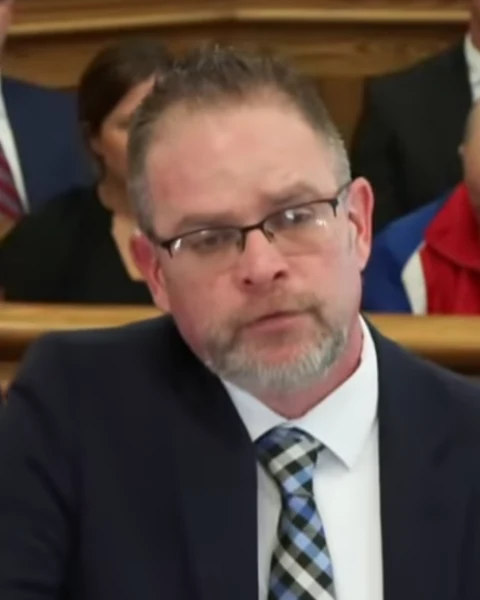
Adam Lally
Courtroom Impact
Adam Lally served as lead trial prosecutor for the Commonwealth of Massachusetts in both the first and second Karen Read trials, partnering with ADA Laura McLaughlin. He delivered the prosecution's opening statement in Trial 1 and examined the majority of the Commonwealth's witnesses — a roster spanning Canton firefighters and paramedics who found O'Keefe, the responding police officers, family members of the victim, and key defense witnesses he cross-examined. His approach was methodical and chronological: he built scenes from the ground up, established witness credibility through detailed qualification, and relied on physical evidence, dashcam video, and Ring camera footage to anchor his narrative. On redirect, he was efficient and targeted, using leading questions to rehabilitate specific vulnerabilities opened by defense cross-examination.
Notable Quotes From The Record
“The defendant stated repeatedly, 'I hit him, I hit him, I hit him.'”
Central prosecution claim — multiple first responders allegedly heard this admission at the scene.
“no one ever exits that vehicle. There are no footprints around that vehicle, there's no damage that they observed to that vehicle at that time.”
Pickup truck witnesses establish that O'Keefe never left the defendant's vehicle and no taillight damage was visible when they arrived — anchoring the timeline for the alleged strike.
“the defendant asks Miss McCabe to look up on her phone how long someone has to be out in the cold to die from hypothermia”
Prosecution frames the 6:23 AM Google search as consciousness of guilt — the defendant allegedly knew O'Keefe was outside in the cold.
“for some perceptible period of time that vehicle travels over 60 feet in reverse at over 20 — approximately 24.2 miles per hour”
Previews the Toyota telematics evidence that the prosecution argues shows the vehicle striking O'Keefe while reversing.
“Did you see anybody from any address on that entire street for the entire 90 minutes that you were there come outside?”
Reinforces that no one from 34 Fairview or any neighboring house emerged during the entire response, countering any suggestion the scene was compromised by residents
“And of those other scenes, does everybody who's a friend or a family member of the person who is injured or deceased — do they all react the same?”
Sets up the point that Read's extreme reaction was not a normal grief response, distinguishing her behavior from the other women present.
“And did you see any blood on Miss Roberts's face or hair?”
Draws implicit contrast with Read, who presumably showed signs of distress or contact, while Roberts did not.
“And your memory of that statement is "I hit him, I hit him, I hit him," correct?”
Lally's closing question locks in Nuttall's testimony on the key admission, leaving the jury with this version as the final word.
“Now, the conversation in which you heard the defendant say "I hit him," and the conversation that firefighter McLaughlin had in which the defendant told her "I hit him" — those are two separate conversations, correct?”
Establishes that Read made the statement to two different first responders independently, reinforcing it as a repeated admission rather than a single overheard remark.
“You have no idea whether or not you were even on scene at that time — that any of those statements that were made in that video were made? Correct?”
Challenges the foundation of the video clip played during cross by questioning whether Kelly was present when the statements were recorded
“So fair to say that everything that you heard may not be everything that someone else that was there from your department that day heard? Correct?”
Opens the door for other firefighters to testify they heard different statements at the scene, counteracting Kelly's testimony that he only heard 'He's dead'
“And just to be clear — just because their last name is Albert, they're separate people. You have separate relationships with each of those persons, correct?”
Lally explicitly distances the 2002 Christopher Albert incident from the 2022 investigation at Brian Albert's residence.
“And as far as any condition of it — specifically the right rear passenger side — you didn't have any occasion to go inspecting that or looking at it at that point, correct?”
Prosecution establishing that Read's vehicle was not inspected by police at this early stage, preserving the chain of evidence for later taillight testimony.
“No redirect.”
Prosecution declines to rehabilitate, suggesting Camerano's cross-examination testimony was not damaging to their case or they had no effective counter.
“'Last he was in the snow.'”
Read's follow-up text at 6:36 a.m. places O'Keefe in the snow, a key prosecution exhibit suggesting Read knew where and how O'Keefe ended up.
“And so as far as what, if anything, went on behind closed doors or in their relationship, you weren't really privy to that.”
Frames Roberts's positive observations of Read as limited to public appearances, implying private dynamics may have differed.
“you saw what they sort of depicted in public, correct?”
Frames the witness's cross-examination testimony about the couple's affection as limited to public appearances only
“As far as what you were relaying, that was what the defendant had said to you at the bar that night?”
Reframes the affectionate remarks as Read's self-presentation rather than objective evidence of a healthy relationship
“And roughly about 210 days or so?”
Reframes 67 calls across 210 days as roughly one call every three days, diluting the defense's emphasis on volume
“What we're requesting is a partial closure of one individual... he be excluded physically from the courtroom while those witnesses are testifying from the stand.”
Defines the narrow scope of the Commonwealth's request — physical exclusion only during specific testimony
“Fair to say that you don't know whether or not an answered call, or something that's listed as answered, was something that was actually answered or went to voicemail?”
Challenges the reliability of the Cellebrite extraction data used during cross to suggest Nicole answered McCabe's calls
“her statement within the report to Trooper Proctor, her grand jury testimony in this case, and her testimony before this jury on the stand were identical, if not entirely consistent”
Prosecution's counter-argument that McLaughlin's statements have been consistent throughout
“And with respect to either of those people or any other people, no one else came into the house while you were there, correct?”
Directly establishes through a non-family witness that John O'Keefe never entered 34 Fairview Road.
“So you weren't looking at sort of the entirety of the front lawn, is that correct?”
Prosecution explicitly establishes the limited scope of her observation to counter the defense's implication.
“Now, if you had realized or had recognized that dark object — 5 to 6 feet long, in that area near the flag pole — had you realized that was a body, what would you have done?”
The central question of this redirect — designed to counter the defense's implication that Nagel's inaction was suspicious.
“So, Miss Maxon, during the time that you were asked about not sort of focusing on the SUV in front of you — fair to say that you would have seen a six-foot man walking away from that car, going towards the house?”
Frames the redirect's entire purpose: converting Maxon's proximity into affirmative evidence that no one exited the SUV.
“from the time that you were in front of the house until you left, you never saw anyone go in or out of that house, or in and out of that vehicle — the black SUV in front of you?”
Consolidates D'Antuono's observation into a single prosecution-favorable framing: no movement between vehicle and house
“if a six-foot man had walked from the SUV to the house, is that something that you think you would have seen?”
Implies that if O'Keefe had walked to the house, D'Antuono would have noticed — suggesting O'Keefe never made it inside
“You were in the bubble of Canton High School at 1:28 in the morning. Could you have possibly been in the bubble of your home at 1:30 in the morning?”
Highlights a logical impossibility in the Life360 data — a seven-to-ten minute drive completed in two minutes — undermining the app's reliability.
“And that is in direct response to the harassment that that witness and her entire family, as well as Mr. Albert, had sustained as a result of actions by several different parties, including counsel.”
Prosecution argues the harassment context was necessary to explain why McCabe delayed producing evidence, and directly references counsel's involvement.
“And with regard to Mr. O'Keefe — your neighbor who lived at the top of the street when you lived at 7 Meadows — you ever threaten him?”
Directly asks the question the defense implied but never posed — whether Albert ever threatened O'Keefe
“So regardless of inches versus feet versus whatever distance it was, you didn't measure that. Is that correct?”
Lally preemptively concedes the measurement point while pivoting to the stronger evidence — photographs showing items exactly where found.
“And as far as the pieces that you've testified to— as far as fitting them mechanically together— all of those pieces then fit mechanically onto the tail light housing taken from the defendant's vehicle, correct?”
Lally's closing question refocuses the jury on the core forensic conclusion after cross emphasized collection timeline gaps.
“At the time that you made those inexcusable and unprofessional comments, what did you believe the defendant had done to Mr. O'Keefe?”
Lally concedes the texts were inexcusable while redirecting focus to the evidentiary basis behind Proctor's conclusions
“What I would say is that I did not show this video and ask this opinion. This is a video that actually the trooper mentioned to me that he had seen over the course of while the case was pending — probably over a year ago.”
Lally attempts to distance himself from actively soliciting the new opinion, claiming the officer independently viewed the video.
“Simply saying 'Well, there were no injuries to the leg so it couldn't have been a motor vehicle collision' is just plain wrong and not backed up by science or anything else that this witness could testify to from the very limited experience she has in that realm.”
Lally's core Daubert argument — Russell lacks foundation to opine on pedestrian crash injuries.
“Did you see anything in there — of any sort of statement, suggestion, intimation, anything at all — that suggested that the injuries or the fracture to the back of Mr. O'Keefe's head was caused by a motor vehicle in terms of direct contact?”
Lally attempts to limit the scope of Wolfe's analysis, but the answer — 'Nothing' — undercuts the Commonwealth's theory on the record.
“I don't really think that's an opinion at all, to be honest with you.”
Lally's fallback argument — if he can't exclude the opinion as outside their expertise, he characterizes it as too vague to qualify as an expert opinion at all.
“This case does not rest or fall with the testimony of Trooper Paul. Trooper Paul's testimony, while important, when taken in conjunction with the remainder of all of the other witnesses and all of the other testimony that the court has heard — that is not the only evidence that the vehicle struck Mr. O'Keefe or interacted with Mr. O'Keefe.”
Prosecution reframes the case as resting on cumulative evidence rather than a single witness's reconstruction theory.
“So do you know that there is actually no street lighting whatsoever in the area of the fire hydrant and the flag pole, or anywhere there for several hundred feet?”
Establishes poor visibility conditions, undermining Loughran's ability to observe details from his plow truck
“Are you sure you didn't see a black Lexus SUV in front of the house at 34 Fairview Road around 5:00 a.m.?”
Prosecution's alternative theory — Loughran saw a different vehicle at a much later time, not Karen Read's Ford Edge at 3:15 a.m.
“So then you were not on Fairview Road at 5:00 a.m., correct?”
Direct challenge to Loughran's claim of observing the scene before first responders arrived
“So my question is: are you talking about coming down Fairview, or are you talking about being on another road and looking at Fairview?”
Lally drew the key distinction between physically being on Fairview Road versus observing it from a neighboring street
“So in the last couple days, you've had time to review a UC Davis report, Dr. Sheridan's affidavit, and any sort of dog bite history, but you haven't had a chance to write a report?”
Highlights the absence of a written expert report despite having time to review additional materials
“Did any of those dog bites that you saw in those photographs look anything like what you observed in the photos that you saw of Mr. O'Keefe's arm?”
Establishes that Chloe's documented bite injuries look nothing like the marks on O'Keefe's arm
“You understand that they both disagree with what your opinion is in relation to those searches?”
Establishes that two other digital forensics experts (Hyde and Whiffin) reject Green's 2:27 a.m. search interpretation
“And subsequently, you've done further testing and that's shown that you were wrong. Correct?”
Forces an explicit concession that Green's affidavit was wrong on the predictive search point
“Are you aware that Cellebrite has had to modify their software based on misinterpretation of data, as you've done in this case?”
Final question frames Green's analysis as the same type of error that required Cellebrite to update its software
“And so you're equally unaware then that when that was tested, there was no canine DNA found from any of those swabbings in the area where the injuries that you're describing as scratch marks or bite marks occurred?”
Directly undermines Sheridan's animal-attack theory with forensic DNA evidence he had not reviewed.
“did you review materials or were you made aware that the defendant said to multiple people on scene, 'I hit him, I hit him, I hit him, I hit him'?”
Introduces defendant's alleged admissions that the expert was never told about
“Were you aware that there were microscopic pieces of red and clear plastic — about a sixteenth of an inch by sixteenth of an inch — that were recovered from Mr. O'Keefe's clothing, and they were then found to be consistent with the tail light?”
Introduces physical evidence linking tail light fragments to the victim's body that the expert never reviewed
“There were also pieces of approximately a sixteenth of an inch by a sixteenth of an inch of clear and red plastic that was subsequently found to be consistent with the defendant's tail light, that was found embedded within Mr. O'Keefe's shirt.”
Confronts the expert with physical evidence linking the tail light to O'Keefe that was not in ARCCA's original analysis.
“I hit him, I hit him, I hit him, I hit him. Those are the words of the defendant — four times. You heard testimony from four different witnesses who overheard and observed those statements from the defendant on January 29th, 2022.”
Opens the closing with the prosecution's strongest evidence — the defendant's own repeated statements to first responders.
“It's a three-card monte — the facts and the evidence in this case are your card, they're the queen of hearts. And so what the defense wants you to do is not look at that card.”
Lally's framing of the defense strategy as deliberate distraction from the evidence.
“Two things can be true at the same time — they're not mutually exclusive: the texts from Trooper Proctor are distasteful, disrespectful, they're unprofessional, there's no defense to — and the defendant killed John O'Keefe.”
Attempts to compartmentalize the Proctor text scandal away from the evidence of guilt.
“53 phone calls from 12:33 a.m. to 6:03 a.m. Zero phone calls to 911.”
Highlights the defendant's failure to call emergency services despite hours of phone activity.
“Facts are stubborn things, and whatever may be our wishes, our inclinations, or the dictates of our passions, they cannot alter the state of the facts and the evidence.”
Closing invocation of John Adams to frame the case as driven by inescapable facts.
“I would submit that it is far, far, far too early in their deliberative process to even consider giving them any kind of Tuey-Rodriguez instruction or anything close to that.”
The Commonwealth's position that insufficient time had passed, framing the note as a progress update rather than a declaration of deadlock.
“they really haven't even had one hour of deliberation equivalent to one day of testimony for each of the days of testimony that they've heard”
Prosecution argues 22-23 hours is insufficient given the scope of the trial, opposing the Tuey-Rodriguez instruction
“And 0.14, 0.28, and every number in between is higher than 0.08. Is that correct?”
Lally's closing question drives home the prosecution's central point — the entire calculated range exceeds 0.08%.
“And so your responsibility, as far as chain of custody is concerned, is from when you retrieve the item during your analysis and then when you return the item to the evidence unit. Correct.”
Frames Vallier's limited chain-of-custody knowledge as standard procedure, not a weakness.
“as far as the chalk that you were presented with on cross-examination, was there anything in there about item 7-18 or item 3-1, either the tail light housing or the debris from Mr. O'Keefe's clothing?”
Lally's strategic highlight that Jackson's demonstrative chart omitted the tail light plastic evidence entirely
Key Moments
- In his Trial 1 opening statement, Lally methodically walked the jury through the entire timeline of January 28–29, 2022 — from drinks at C.F. McCarthy's through the drop-off at 34 Fairview Road and the discovery of O'Keefe's body — previewing nearly every witness and evidence category in a dense, chronological narrative designed to establish the Commonwealth's theory before a single witness took the stand.
- Lally's examination of the Canton fire and EMS crew — Flematti, Nuttall, Kelly, McLaughlin, and Walsh — formed the spine of the prosecution's early case, eliciting each first responder's account of finding O'Keefe unresponsive and, critically, their testimony that Karen Read repeatedly stated 'I hit him' at the scene, a statement the defense would spend the trial contesting.
- During his cross-examination of Brian Loughran, a defense witness who claimed to have driven past 34 Fairview Road in the hours before O'Keefe was found, Lally deployed a sustained impeachment: he confronted Loughran with a prior May 2023 interview report containing materially different times, used Loughran's own route timeline to argue his claimed pass was too late to support the defense's theory, and established that Loughran had met twice with defense attorney Yannetti in the week before testifying — drawing a picture of a coached witness with inconsistent accounts.
- Lally conducted voir dire of Officer Michael Lank mid-trial to rehabilitate him after defense cross-examination raised his connections to the Albert family, establishing that Lank had charged an Albert family member in an unrelated matter — a move designed to preempt any inference of bias in Lank's scene investigation and the later discovery of taillight plastic on February 4, 2022.
- Across both trials, Lally handled redirect examinations for virtually every prosecution witness who faced cross-examination, consistently using a structured, point-by-point approach to address each vulnerability the defense had opened — reinforcing Karen Read's scene statements, recontextualizing physical evidence, and closing off alternative narratives before the witness left the stand.