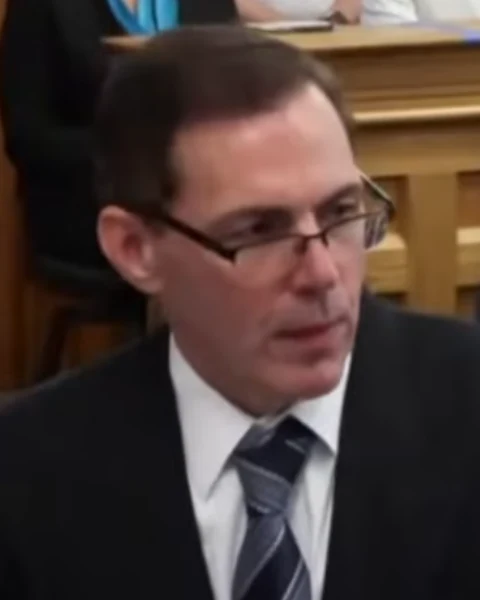
Hank Brennan
Courtroom Impact
Hank Brennan served as Special Assistant District Attorney for the Commonwealth in the second trial of Karen Read, taking the lead prosecution role that Adam Lally had held in Trial 1. Brennan delivered the opening statement framing the case around a minute-by-minute digital timeline, and went on to examine 20 witnesses across 87 proceedings — from first responders and eyewitnesses to digital forensics experts and the central witness Jennifer McCabe. His approach was methodical and data-driven, building each examination in careful layers and using open-ended questions to let witnesses narrate events in their own words before zeroing in on critical details. He also conducted aggressive voir dire challenges against defense experts Daniel Wolfe and Andrew Rentschler, attacking their independence and communications with the defense team.
Notable Quotes From The Record
“And he looked up at Ms. Read and he said, 'What happened?' And you'll hear her words to firefighter Nuttall — she said, 'I hit him. I hit him. I hit him.'”
Central prosecution evidence — Read's statement to the first responder at the scene, which Brennan frames as an admission.
“She then put the Lexus into reverse, put her foot on the gas pedal, and began to press. Not 25%, not 50%, up to 75% acceleration.”
Prosecution's reconstruction of the collision using black box data, establishing intentional acceleration as the basis for the murder charge.
“We are not going to try to prove that Karen Read tried to kill John O'Keefe. We're not going to try to prove to you that she intended or wanted him dead. That's not second-degree murder.”
Brennan preemptively addresses the murder charge standard, clarifying the prosecution need only prove an intentional act creating a plain strong likelihood of death.
“That cell phone — it is the best of historians. It doesn't suffer from intoxication. It doesn't suffer from memory loss. It doesn't suffer from emotion, pride, or bias.”
Signals the prosecution's strategy of anchoring the case in digital evidence rather than witness credibility.
“I mean, I didn't think I could hit him, but could I have clipped him? Could I tag him in the knee and incapacitated him. He didn't look mortally wounded as far as I could see.”
Post-charge media statement played for the jury in which Read contemplates having struck O'Keefe — prosecution frames this as confirming their theory.
“Sir, in Mr. Jackson's questions, he asked if you had ever said that you heard the defendant say, "I hit him," separate from when she approached you. Do you remember previously testifying that you heard her saying, "I hit him," in the background, separately from you?”
Frames the redirect's sole purpose — establishing prior sworn testimony about the background statements
“it is powerful evidence showing her heart rate is inconsistent with being in a criminal conspiracy. Yet we provided it in advance so they'd have notice days before Trooper Guarino would even testify about it.”
Prosecution frames McCabe health watch data as rebuttal to defense conspiracy theory about the 2:27 a.m. call, while positioning disclosure as collegial rather than tactical.
“They get into two cars and they drive away and remove the Lexus with the broken tail light from the scene. That is clear consciousness of guilt evidence — removing the murder weapon from an area where witnesses can see, photograph, identify the damage.”
Core of the prosecution's theory for admitting the clips — removing the vehicle was evidence concealment.
“This is a statement of the defendant. It's in the form of an admission — a statement which qualifies for admission substantively, not for impeachment purposes.”
Prosecution's rebuttal — party admissions bypass the impeachment restriction.
“I need to give it some thought. I'm not willing to agree. I'll abide by whatever the court thinks is fair.”
Prosecution reserves position on the expert testimony access question rather than agreeing outright.
“When you're at that block party, do you ever step out and have secret meetings with Kerry Roberts trying to concoct some conspiracy on their behalf?”
Directly confronts the defense's implication that Whitley's Canton connections compromise his testimony.
“It's date unclear, not January 22nd, 2022. So the weather will be very different. The temperature will be different. The conditions will be different.”
Prosecution preemptively addresses that the scene will look different than on the night of the incident.
“When you look at that tail light, it will be different than the photograph that is in evidence. It has been removed.”
Alerts jury that the Lexus tail light — key physical evidence — has been removed from the vehicle since the photographs in evidence.
“You knew the Signal calls were communications, didn't you? ... And you never informed — in your response — that there were phone calls through Signal as part of your communications, did you?”
Establishes that Wolfe's response to the court production order omitted Signal communications entirely.
“So you sent him what you thought would be the best questions and answers for him to ask you when you testify.”
Frames the 'Wolfe Direct' email as substantive trial preparation with the defense, contradicting Wolfe's claim of no case discussions.
“And so as far as you knew, this came out of nowhere in March that the defense wanted to use ARCCA — or specifically you and Dr. Rentschler — in late March of 2025.”
Frames the defense's delay in securing ARCCA as prejudicial to the Commonwealth's ability to prepare a rebuttal.
“And by calling and raising issues and telling you information, even if you weren't requesting it, it helped prepare you for your trial testimony, didn't it?”
Brennan frames the DOJ communications as de facto trial preparation regardless of Rentschler's intent.
“Dr. Wolfe admittedly destroyed over 100 text messages.”
Key factual basis for the Commonwealth's claim that discovery was obstructed.
“What we unfortunately learned is that during the trial, when this court had a sequestration order, information was being passed to the experts about witness testimony in this case, unknown to the Commonwealth, unknown to the court.”
Core of the Commonwealth's argument — that ARCCA experts received improper coaching through defense intermediaries during Trial 1.
“she offered to John O'Keefe, which was heard by the defendant, the house is near Bella's mom's house. That is evidence of motive.”
Prosecution's theory: Read's awareness of O'Keefe's connection to another woman establishes jealousy as motive.
“Was the light inside the house from your memory illuminating the ground near the flag pole and that fire hydrant?”
Directly challenges the defense premise that lighting conditions would have revealed anything on the lawn.
“When you came out of the house and went to the car, were you looking at or studying the flag pole area or the bushes or the fire hydrant in that area?”
Establishes Levinson had no attention directed toward the area in question, explaining why she saw nothing.
“Did you know whether it was with a fist or a foot? ... Or a Lexus?”
Establishes that Read's statement was ambiguous and McLaughlin had no reason to interpret it as a vehicular confession
“Your honor, have you ever learned one fact that would have justified searching that house?”
Brennan frames the entire search warrant debate as a single yes-or-no question to leave the jury with a clean takeaway.
“Did you happen to pay any particular attention to the right side of the back of that car that morning?”
Prosecution specifically establishes Rae did not inspect Read's vehicle, anchoring the timeline of when taillight damage was or wasn't observed.
“She has not been deemed unreliable. It is the issue of the significant locations by that court that they found insufficient. There's no opinion from a court that she's an unreliable expert, and this is how they're going to distort it.”
Prosecution's core rebuttal — the Maryland ruling was issue-specific, not a blanket finding against Hyde's competence.
“Did anybody ever provide you any of this additional information you weren't aware of at the time, ask you to evaluate it, and then reconsider your finding?”
Highlights that despite significant evidence emerging after the death certificate, no one asked the ME to reassess
“It does not change the text screen data or the blackbox information on the car whatsoever. It does not change ARCCA's analysis whatsoever.”
Prosecution's position that the amended timestamp is a clarification, not new evidence
“There are no changes in the timeline. He keeps trying to portray this as something that has changed. Nothing has changed.”
Commonwealth's central position — the clock drift analysis refines existing data rather than introducing new evidence.
“The ultimate issue is manslaughter or mens rea for second-degree murder, not collision. They don't get to define the prosecution's case.”
Prosecution reframes the ultimate issue as guilt, not collision, to preserve expert opinion testimony
“We expect to ask Dr. Welcher does he have an opinion to a reasonable degree of engineering certainty whether the defendant's Lexus collided with Mr. O'Keefe on January 29, 2022 around 12:32 a.m.”
Previews the exact opinion question at stake in the dispute
“They are trying to pit the inadmissible opinion of a non-testifying witness against a testifying witness.”
Prosecution's framing of the defense strategy as an attempt to introduce non-testifying expert opinions through cross-examination.
“Your Honor, the Commonwealth rests.”
The formal announcement ending the prosecution's case-in-chief in Trial 2.
“There are tail light fragments from the defendant's own Lexus from her shattered right tail light that are found in Mr. O'Keefe's clothes.”
Prosecution's strongest physical evidence linking Read's vehicle to O'Keefe's body.
“So you're essentially double dipping. You're adding 3 seconds that has already been separated because it isn't reflected on the infotainment system. Isn't that true?”
Central challenge to DiSogra's methodology — argues the 3-second key-on delay adjustment counts time already excluded from the infotainment clock
“If those first five calls were iPhone to iPhone rather than infotainment to iPhone, would you agree they should not have been considered in your analysis?”
Forces DiSogra to concede the conditional that would eliminate a large portion of his scenario analysis
“This demonstrates the difficulty in giving opinions when you don't actually study the data itself. Isn't that fair to say?”
Frames the central attack: DiSogra criticized reports without doing independent analysis
“Did you know at 12:32:16 that John O'Keefe's cell phone moved for the last time? Did you know that?”
Introduces a critical timeline fact — O'Keefe's phone last moved 4 seconds after the Techstream window ended, suggesting the data capture missed what matters most
“I am not opposed to the admission of bias against a witness, especially a police officer, but it should be against that witness, because they need to have the opportunity to admit, deny, define, accept, and explain.”
Brennan concedes the texts show bias but argues fairness requires confronting Proctor directly rather than introducing texts through a third party
“Mr. Proctor says, 'From all accounts, he didn't do a thing wrong. She's a whack job.' And then uses the C word to describe. Is that accurate?”
Brennan chose to read the most offensive texts himself rather than force the witness, controlling the presentation while still getting the content before the jury.
“Do you know he was not fired for any accusations of planting or tampering with evidence?”
Directly addresses the defense theory that Proctor's misconduct extended to evidence tampering, using Diamandis's lack of knowledge to leave the point unanswered rather than confirmed.
“Regardless of whether an attorney has that power, were you threatened that there would be a charge of perjury if you didn't comply with the defense wishes in this case?”
Brennan neutralizes Jackson's redirect point that attorneys cannot charge crimes by reframing the issue as whether the threat was made, regardless of legal authority to carry it out.
“Other than this case, there was never ever a time in your career where you were presented with a photo and asked to give an opinion whether the mechanism of injury was a dog bite, other than this case.”
Establishes that Russell has zero prior forensic experience identifying dog bites from photographs.
“At the beginning, before your opinion evolved, you started with an opinion that this could have been either bite or scratch wounds, right?”
Highlights that Russell's testimony has become more definitive over time, suggesting her opinions solidified rather than being based on initial analysis.
“If I cannot cross-examine her as proposed by the defense about the heart of her opinion, she shouldn't give it. She shouldn't have an opinion, because you can't come in and just take the favorable factors to yourself and leave out reality.”
Core prosecution argument — a defense expert's opinion is subject to full cross-examination including unfavorable evidence she considered.
“Because they specifically opened the door when they had her vouch for her own credibility, extolling her uniqueness and ability to determine that these were dog bite wounds.”
Brennan's legal argument for admitting the Walsh report — that the defense's own credentialing of Russell entitled the prosecution to show other experts disagree.
“Is that gratuitous answer part of your advocacy or a part of your medical objective opinion?”
Directly challenges Russell's claimed neutrality after she volunteered information favorable to the defense.
“You can't tell us one step that went wrong with that DNA process, can you?”
Pins Russell down on having no factual basis for discounting the negative dog DNA results.
“So attorney highlighted the parts he wanted you to read to the jury.”
Establishes that the redirect reading of peer-reviewed articles was curated by defense counsel, not an independent scientific presentation.
“They name three things that are characteristic traits of a dog bite. And you would agree not one of those three traits is present on the arm of Mr. O'Keefe. Would you agree with me?”
Culminating question forcing Russell to admit the articles she relied on actually undercut her opinion.
“So respectfully, sir, your memory about distinguishing that photo is not as you thought it was and claimed it was in this transcript. Correct?”
Brennan crystallizes the memory-fallibility point — Barros had a confident, specific memory of testimony that demonstrably did not occur.
“Since you didn't tamper with it or try to remove anything, that could impede your ability to accurately observe the depth of the damage? Would you agree with that?”
Establishes that snow accumulation on the vehicle limited Barros's ability to fully assess the tail light damage, offering an alternative explanation for the perceived discrepancy.
“You would agree that your memory has changed since last time you testified in this courthouse?”
Establishes that Barros's recollection has shifted, framing his direct examination testimony as less reliable than his current concession.
“And it's different than the 3:30 to 4 timeline that you gave the defense private investigator the first time you spoke to them.”
Summarizes the core impeachment — Loughran gave materially different times for his final Fairview pass across four separate accounts.
“You don't have your watch out on a certain schedule that you have to pass a certain street at a certain time.”
Establishes the foundation that all of Loughran's times are estimates, not recorded facts
“And sir, do you notice the big red dumpster to the right side across from Fairview?”
Uses the unnoticed dumpster to undermine Loughran's claim of careful observation while plowing past the Albert residence.
“You were no longer being harassed. You were being embraced.”
Distills Brennan's entire theory — that Loughran's testimony is shaped by social incentives from the pro-defense community.
“Was your last image of Karen and John both of them walking to the car — and Karen walking to the driver's side door of that car?”
Establishes through a defense witness that Read was driving when the couple left the bar.
“That night was particularly different. He was extraordinarily proud and happy, wasn't he?”
Humanizes the victim, emphasizing his emotional state on the last night of his life.
“Why did you invite somebody else to interject in your independence and guide you to leave something out?”
Highlights Wolfe's pre-testimony notes offering to omit information at the defense's discretion, contradicting his independence claims
“Name one journal, one paper, one study that supports your proposition that you're relying on as the basis of your opinion in front of this jury today. Name one.”
Establishes Wolfe has zero published support for using a Hybrid III crash dummy arm to assess clothing tears and skin abrasions
“So weight does kind of matter, right?”
After extensive questioning about the 26% arm weight difference, Brennan forces the concession that undermines Wolfe's claim the discrepancy was insignificant
“Give me a name, an author. One paper, one study that supports using a 9.38 arm, 50th percentile, when you're doing a crash test for somebody who's in the 95th percentile, who weighs 216 pounds and they're 6'1. One paper, sir.”
Forces Wolfe to concede he has no published authority supporting his choice of test arm size
“So you were comfortable just coming in with no experience in this whatsoever without even studying or doing any research. You were comfortable to come in and just throw out an opinion?”
Crystallizes the attack on Wolfe's qualifications to opine on fabric damage
“Your honor, my brief review of the lab paperwork and looking at the hoodie, it appears that I made a mistake.”
Prosecutor concedes the error, characterizing it as inadvertent rather than intentional.
“Can you remember the name of the last class or seminar that you took or completed that has to do with wound pattern recognition relative to dog bites?”
Core of prosecution's challenge — Laposata could not identify any specific training beyond general forensic pathology education
“Your honor, we can always object even during trial for a foundational issue.”
Commonwealth's legal basis for raising the challenge mid-trial despite missing the pretrial deadline
“So suffice to say if you were to leave the front door and come back to that spot, it would be an additional 65 ft back, right?”
Establishes the round-trip framing — doubling each measurement to emphasize total distance traveled
“If you were to measure from the flag pole up the street, up the driveway to the middle door — that would be well over 80 ft.”
Establishes that alternate route measurements from the flag pole exceed 80 feet to every entrance
“There are a number of slides that attempt to frame what the contested issues are of the case in the proper opinions. It assumes facts not in evidence and is properly summarized in overall position. There are a number of slides that provide credibility determinations about Dr. Welcher”
Previews the Commonwealth's objections to Dr. Rentschler's PowerPoint presentation
“There were no reports, incomplete reports, and unsigned reports of over 1,500 individuals between June 30th, 2000 to June 30th, 2005.”
Foundation for Commonwealth's impeachment of Dr. Laposata based on the Rhode Island audit
“I have not hired Dr. Laposata four or five times, and that is just a mischaracterization he likes to do for the public.”
Brennan pushes back on Jackson's suggestion that his own prior use of Laposata undermines the credibility attack
“And so if you didn't look at all the evidence and you disregarded some of the evidence because you had already made up your mind, that really wouldn't be the proper study of differential diagnosis, would it?”
Establishes the framework for attacking Laposata's methodology — she excluded vehicle strike before reviewing vehicle evidence
“You have no other cites whatsoever supporting that proposition, which led inevitably to one of the opinions you gave to this jury. True.”
Culmination of Brennan's methodical dismantling of Rentschler's three cited references, none of which endorsed crash test dummies for skin injury analysis.
“I'm objecting. It's not admissible. It's [unintelligible]. It's a strategic decision. The past introductions have been strategic.”
Brennan frames the PowerPoint objection as a matter of trial tactics, arguing both sides made strategic choices about what to admit.
“What else do — Mr. Jackson — after the defendant rests, we will not be calling any witness, putting on any further evidence.”
Defense formally rests its case in Trial 2.
“She was drunk. She hit him and she left him to die.”
The prosecution's central refrain, repeated throughout the closing to distill the case to its simplest formulation.
“Data is data. The black box, the forensics from the SD card. We know exactly step by step where they were.”
Encapsulates the prosecution's strategy of anchoring the entire case in digital forensic data rather than witness testimony.
“Nobody knows where you are. It is 12:59. John O'Keefe has been on that lawn for about 27 minutes. She hasn't called anybody else.”
Uses Karen Read's own voicemail to argue she knew O'Keefe's location because she was the one who left him there.
“She calls Kerry Roberts. It's no longer she left him at the Waterfall. She pivots... Kerry, Kerry, John's dead. I think he got hit by a plow.”
Brennan argues Read's shifting story — from 'left him at the Waterfall' to 'hit by a plow' — demonstrates consciousness of guilt and an attempt to substitute another large vehicle for her Lexus.
“We don't need Proctor to prove this case beyond a reasonable doubt. That's why I didn't introduce that evidence to you.”
Directly addresses the Proctor misconduct issue by arguing the prosecution deliberately avoided relying on evidence collected solely by the disgraced trooper.
“We didn't introduce any evidence in this case and say you should give it any weight, if any, at all. We didn't provide a limiting instruction in any way and these shouldn't be so limited.”
Prosecution argues Read's interview clips should be treated identically to all other evidence without qualifying language.
“Mr. Jackson said explicit acquittal. I don't like that language. I think if you find it, it means you have found her not guilty of each of the others.”
Prosecution objects to framing a lesser-included guilty finding as an 'explicit acquittal' of higher charges, preferring softer language.
“The Commonwealth moves to sentencing. We recommend probation, one year. Twenty-four-D program. So the standard that everybody else gets on their first time.”
The prosecution recommends the standard first-offense OUI sentence, signaling no request for enhanced penalties.
Key Moments
- Brennan's multi-day direct and redirect of Cellebrite expert Ian Whiffin was a centerpiece of the prosecution's digital case, walking the jury through Jennifer McCabe's phone search timing and four independent data streams from O'Keefe's phone — location, health, battery temperature, and pocket state — to reconstruct the timeline of O'Keefe's death second by second.
- During voir dire of defense expert Daniel Wolfe, Brennan revealed that Wolfe had emailed a full direct examination outline with strategic commentary to defense attorney Jackson, deleted approximately 100 text messages with Jackson after Trial 1, and used Signal at Jackson's request — a coordinated attack that exposed the depth of Wolfe's collaboration with the defense and cast doubt on his claimed independence.
- Brennan conducted Jennifer McCabe's direct examination across three days, meticulously establishing the timeline from the evening at the Waterfall bar through the discovery of O'Keefe's body, including the 2:27 a.m. Google search for 'how long to die in cold' and McCabe's phone activity in the critical overnight hours — the prosecution's sharpest circumstantial evidence against the defense's cover-up narrative.
- In his opening statement, Brennan anchored the Commonwealth's theory with a data-centric reconstruction of the night, using O'Keefe's phone data as a minute-by-minute timeline before closing with Karen Read's own post-charge words — framing the jury's task as reading the digital record rather than relying on contested witness accounts.
- Brennan's redirect of paramedic Jason Becker systematically dismantled a defense inference by walking through every prior statement Becker had made — EMS report, grand jury, and Trial 1 testimony — to demonstrate that Becker had consistently described Karen Read referencing an 'argument' and had never once mentioned voicemails, directly neutralizing the defense's attempt to introduce an alternative explanation for Read's behavior.