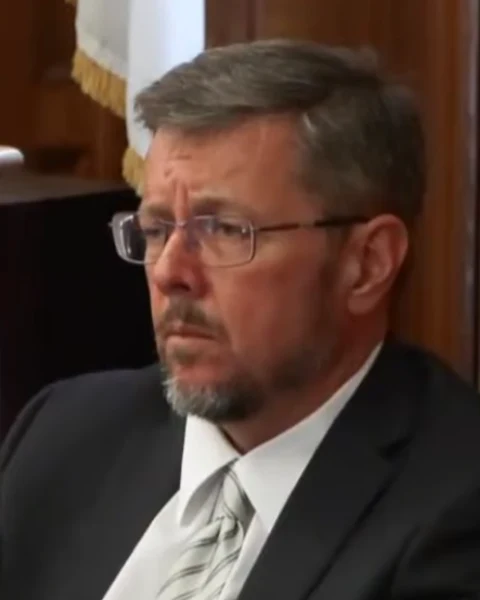
Judson Welcher
Testimony Impact
Judson Welcher is a forensic engineer and accident reconstructionist with over 30 years of experience and ACTAR accreditation, hired by the Commonwealth through Aperture LLC to analyze the physical evidence in the death of John O'Keefe. His testimony spanned three days across Trial 2 Days 21–23 and covered vehicle data analysis, photogrammetric reconstruction of Ring doorbell footage, pedestrian impact biomechanics, and tail light damage assessment. He concluded that the damage to Read's Lexus tail light and O'Keefe's arm injuries were consistent with a collision at speeds above approximately 8 miles per hour, and that a backward fall after such a strike could account for O'Keefe's fatal head injuries.
Notable Quotes From The Record
“Mr. Brennan.”
Welcher confirms it was the prosecutor who suggested changes to his presentation, raising questions about independence of expert testimony.
“I wouldn't say it's insignificant. Again, I haven't modified my PowerPoint at all. I was happy with the data I had and satisfied with the data I had. Again, once presented — as an engineer would — with better data, we use better data.”
Welcher frames the change as standard engineering practice while conceding it is not insignificant.
“You do.”
Welcher concedes the key point that the Burgess variance shifts the trigger window to partially overlap with the device lock event.
“I have no dog in this fight. I don't, quite frankly, care. What I'm doing is trying to do a good engineering job, which is looking at the data and drawing sound principles and sound conclusions from the data.”
Welcher establishes his claimed objectivity and data-driven methodology for the jury.
“That impact did not break or crack that tail light... That's to a high degree of engineering certainty.”
Welcher eliminates the driveway contact at O'Keefe's residence as the cause of tail light damage, pointing to a different event.
“The location and orientation of the laceration on John O'Keefe's right forearm and arm are consistent with the geometry and orientation of the right tail light of the Read 2021 Lexus LX 570.”
Links O'Keefe's arm injuries directly to the broken tail light geometry through exemplar vehicle testing.
“So even at a fall height as low as 40 inches onto a hard surface, you can get fairly severe skull fractures.”
Addresses the skull fracture mechanism — establishes that a backward fall after being clipped could cause the observed head injuries.
“It is consistent with a collision as long as it's greater than approximately 8 miles an hour.”
Sets the speed threshold for his opinion that the Lexus tail light damage is consistent with striking O'Keefe.
“That it is consistent with being struck by a Lexus and ultimately contacting a hard surface such as frozen ground.”
Core prosecution opinion linking O'Keefe's injuries to a vehicle strike followed by ground impact.
“So when you have glancing contacts, you can have much higher speeds without a lot of damage to the car because you're only in momentary contact and it's a glancing type hit.”
Explains the biomechanical basis for limited vehicle damage despite a potentially injurious impact.
“Yes, you could definitely have this type of impact and not have anything beyond, say, red marks to the lower extremity.”
Directly addresses the defense argument that absence of leg fractures undermines the vehicle-strike theory.
“I don't quite frankly care whether it's new or not. I just care what's in the data. Whether it's new, old, I don't care. It's not relevant to what I'm doing.”
Welcher dismisses concern about Burgess's mid-trial amended report, which Alessi uses to suggest the prosecution team was generating new analysis during trial.
“I have certainly done amended analysis. Only certain courts and certain legal systems require reports. But for example, rebuttal — analyzing testimony that comes up in court, getting trial transcripts — I very frequently have come up with new analysis during the trial.”
Welcher distinguishes amended analysis from amended reports but cannot cite a single case where he submitted an amended report mid-trial.
“Correct. We don't have that level of certainty. We have that the height and geometry matches.”
Welcher concedes he cannot say with certainty that O'Keefe's head was positioned to be struck by the spoiler, undermining the eye laceration theory.
“We don't have enough information to determine that.”
Welcher admits he cannot determine how long the arm needed to maintain contact with the tail light to produce the observed wounds — a core gap in the prosecution's injury mechanism theory.
“I did not use his report at all. It was simply limited to the use of the photo to show a different demonstrative issue.”
Directly rebuts the cross-examination suggestion that Welcher borrowed from Trooper Paul's work.
“I wanted it to be independent in my analysis.”
Establishes Welcher's intent to conduct wholly separate analysis from other prosecution experts.
“No, I wouldn't take a person like that — opinion for that.”
Welcher distances himself from the medical examiner's cause-of-death conclusions, asserting that biomechanical analysis requires different expertise.
“Correct.”
Final concession that the highlighted autopsy findings were considered as part of his analysis, undermining the redirect's distancing effort.
“The important things that I was looking at are the underlined or highlighted, which is why I highlighted them.”
Welcher's attempt to narrow which parts he relied on inadvertently confirms he actively selected and considered specific autopsy findings.
“Nope. But we have videos from both of them and scans of the scene.”
Welcher concedes he doesn't have the model numbers for either Ring camera used in his photogrammetry analysis.
“I don't know. We were matching the photos. So I don't care what the numbers are. I care that the height is the same.”
Welcher dismisses the importance of documenting specific suspension measurements, undermining the precision he claims for his analysis.
“I only have it two days later.”
Acknowledges the suspension height measurement is from two days after the incident, not from the night in question.
“No, the impact didn't register the event. As I pointed out, the trigger — the trigger was from when the accelerator pedal went to 30%... So, the TechStream will never register an event even if you hit a wall at 100 miles an hour — necessarily.”
Critical concession that TechStream data cannot confirm a collision occurred — it only records acceleration/braking events, not impacts.
“Absolutely not. It would have shown up as increased error when we overlaid the point clouds onto the photos— or the point clouds onto the video. If it was an error, it would have showed an error.”
Directly addresses the camera replacement challenge — Welcher explains the methodology has a built-in error check
“So when you look at the failure loads, it depends on what you're doing it with. If I hit you with a 5-lb 2x4 or a 5-lb pillow, they're both 5 lb, but you'd much rather get hit by the pillow than the 2x4.”
Welcher reframes the force calculation challenge by explaining distributed vs concentrated loads, undermining the bone fracture threshold numbers from cross
“No, I don't even know what that is.”
Welcher denies knowledge of Signal, distancing himself from any suggestion of hidden communications with prosecutors
“No. Again, these are direct readings from the vehicle. Again, that speed on this here— you have to correct for the slippage, which I do later on the slide, but that is a direct reading from what the speedometer is seeing.”
Establishes vehicle speed data as objective sensor output, countering confirmation bias allegation
“So theoretically, my confirmation bias starts with a bias that it didn't happen.”
Welcher's attempt to defend his methodology by invoking null hypothesis approach, which Alessi then dismantles by showing no documentation of that process
“No.”
Welcher concedes he has no slide or document presenting the alternative hypothesis of no contact, despite 130 slides of presentation material
Key Moments
- Before Welcher took the stand before the jury, defense attorney Alessi used a voir dire examination to establish that prosecutor Brennan had initiated last-minute changes to Welcher's PowerPoint presentation during the active trial — a moment that framed the independence of his analysis as a contested issue from the outset.
- Welcher presented Toyota TechStream vehicle data showing two distinct triggering events in Read's Lexus, with the second event showing the vehicle accelerating rapidly in reverse — 34 feet forward followed by 53 feet back — which he argued was consistent with striking a pedestrian.
- Using exemplar tail light geometry and pedestrian impact testing, Welcher linked the location and orientation of lacerations on O'Keefe's right forearm directly to the broken tail light assembly of a Lexus LX 570, presenting this as physical corroboration of his collision hypothesis.
- During cross-examination, Alessi revealed that Welcher had performed detailed force calculations for the head injury — arriving at 7,200 pounds — but had performed zero comparable force calculations for the arm injuries, which Welcher argued were the primary mechanism of contact.
- In the final recross, Alessi established that Welcher could not point to a single documented moment where he tested or recorded an alternative hypothesis of no contact between the Lexus and O'Keefe, undercutting his stated null-hypothesis methodology despite his claims of starting from a neutral position.