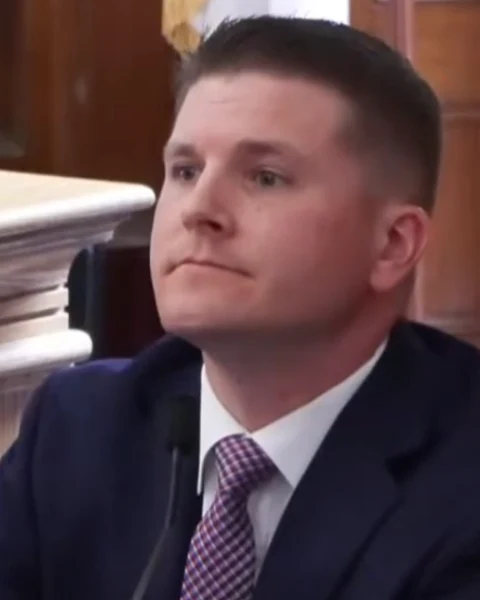
Connor Keefe
Testimony Impact
Connor Keefe is a Massachusetts State Police trooper assigned to the Norfolk DA's CPAC homicide unit, with additional duties as a digital forensic examiner. At the January 29, 2022 scene, he obtained consent forms, extracted phones from Jennifer McCabe and Kerry Roberts, and collected physical evidence including taillight fragments and a black Nike shoe. He also attended John O'Keefe's autopsy with Michael Proctor, whom he identified as the lead investigator. Keefe said Proctor wrote the Sarah Levinson interview report without Keefe's input; he separately testified that he and Bukhenik retrieved two bar videos while Proctor analyzed them and wrote the reports.
Challenges & Responses
What attorneys challenged during examination and how the witness responded.
On cross-examination, Keefe said he did not recall participating in the Sarah Levinson interview with Proctor. After reviewing Proctor's report, he said his recollection was refreshed and acknowledged that he had participated. Yannetti also pressed Keefe on his distinction between providing 'input' and providing 'facts' during the autopsy process, challenging the precision of his answer.
Notable Quotes From The Record
“I am assigned to the homicide unit where we investigate homicides, unattended deaths, suicides, stuff like that. And I'm also a digital forensic examiner at the district attorney's office.”
Establishes Keefe's dual role and qualifications for handling both physical evidence and digital forensics.
“I obtained a consent form and their cellular device.”
Documents that McCabe and Roberts voluntarily surrendered their phones with consent forms — not via warrant.
“I conducted a forensic extraction on those devices.”
Confirms Keefe performed the GrayKey extraction but clarifies his role was limited to copying, not analysis.
“If you're processing multiple things at once, you're bagging things at different times. Then when you seal the bag, that could be the time that is annotated on the bag.”
Explains why evidence bag timestamps may not match the actual time items were discovered — relevant to timeline reconstruction.
“I did not have any input on how he wrote this report.”
Establishes that Keefe said he had no input into how Proctor wrote the Sarah Levinson report.
“I only obtained a copy of the surveillance video. I did not do any analysis on the video.”
Illustrates Keefe's testimony that he retrieved the surveillance video but did not analyze it.
“Not when I was there.”
Keefe testified that no defense attorney or expert was present while he was there at O'Keefe's autopsy.
“We don't give input. We give the facts that we know so far in the case.”
Records Keefe's distinction between providing known facts and providing input during the autopsy discussion; he also denied providing a theory.
Key Moments
- Keefe established that Jennifer McCabe and Kerry Roberts surrendered their phones voluntarily via consent forms — not under warrant — and that he personally performed the GrayKey forensic extraction, though his role ended at copying the data, with all subsequent analysis handled by Proctor.
- Keefe explained that evidence bag timestamps can lag behind actual discovery times when multiple items are being processed simultaneously, a detail relevant to the defense's timeline arguments about when physical evidence was collected at the scene.
- Keefe identified Proctor as the lead investigator and said Proctor wrote the Sarah Levinson interview report without Keefe's input into that report's wording. He separately testified that he and Bukhenik retrieved surveillance video from C.F. McCarthy's and the Waterfall, while Proctor analyzed the videos and wrote reports. Yannetti used those role distinctions to advance a broader investigative-control theory.
- Keefe confirmed that no defense attorney or independent expert was present at O'Keefe's autopsy, a point Yannetti used to underscore the one-sided nature of the post-mortem examination.
- Keefe said he did not recall a joint Sarah Levinson interview with Michael Proctor; after reviewing Proctor's report, he said his recollection was refreshed. He testified that he had no input into how Proctor wrote the report and that he obtained, but did not analyze, surveillance video—testimony Yannetti used to advance a broader theory of investigative control or bias.