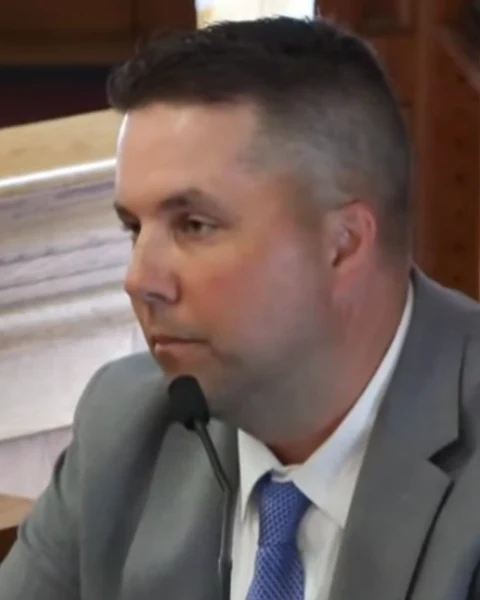
Person Sean Goode Trial 1← All People
👮 Law Enforcement · Canton PD

Sean Goode

Trial 1

Testimony Impact

Sgt. Sean Goode served as the Canton PD midnight shift supervisor on January 29, 2022, and was the first officer to respond to 34 Fairview Road after Jennifer McCabe's 911 call at 6:04 a.m. He testified about the sequence of pre-dawn contacts with police, the chaotic scene upon arrival, Karen Read's statements and behavior, and the initial evidence recovery efforts. His testimony spans two trial days and covers both the prosecution's account of that morning and significant defense challenges to the integrity of his police report and the crime scene itself.

Notable Quotes From The Record

“He has a satellite office in our department. He has his own scan card — he doesn't have to check in with myself or anybody. But he works out of our station.”

Establishes Brian Higgins' unrestricted access to Canton PD, relevant to his movements that night.

“I remember at one point during the evening he came in. I don't remember if he came into the dispatch or if I just saw him on one of the numerous monitors we have in dispatch.”

Places Higgins at the Canton police station around 1:30 a.m. on the night O'Keefe died.

“I received a phone call from a woman — generally asking if we had locked up or transported a male party that evening. It's not uncommon — people call and say, 'Hey, did you lock up so-and-so?' or 'Did you stop anybody?' She said some version of: he was out with friends, he didn't come home tonight, and his girlfriend's worried about him.”

Describes Kerry Roberts' pre-dawn call — first contact with police about O'Keefe's disappearance, framed as routine inquiry rather than emergency.

“At 6:04 a.m. on the 911 dispatch console, I received a call from a woman at 34 Fairview.”

Establishes the precise time of the emergency 911 call that triggered the police and medical response.

“It was terrible — heavy snow, wind, visibility was awful.”

Establishes severe weather conditions at the time of response, relevant to scene conditions and evidence preservation.

“She was yelling out, 'Is he dead?'”

Read's repeated question about O'Keefe's condition — her demeanor and statements at the scene are central to the prosecution's narrative.

“I asked her if she had driven there. She said, 'I think so.' And then right after that she said, 'I don't remember.' Because of her state, I decided to stop questioning there. She couldn't keep her train of thought.”

Read's inability to account for how she or O'Keefe arrived at Fairview Road, and Goode's assessment of her mental state.

“We have no idea why John O'Keefe is laying on the front lawn of a house. We have no — the statements from the three people — we need to figure out what happened last night, that night.”

Goode explains why police needed to speak with the Albert homeowners — no one could account for O'Keefe's presence on their lawn.

“It exposed the blood and small drinking glass, broken.”

The leaf blower revealed physical evidence buried under snow at the spot where O'Keefe was found.

“My cruiser camera pans the front yard of 34 Fairview, and it shows the snow undisturbed — no footprints, any tracks, anything like that leading anywhere.”

Dashcam evidence showing no footprints in the snow on the 34 Fairview lawn — relevant to how O'Keefe ended up on the lawn.

“With regard to the remainder of the time that you were on scene — all the way through 7:50 in the morning — did you ever see Brian Albert come out of his home? — No.”

A trained first responder and Boston police officer inside the house never emerged while emergency vehicles with lights and sirens responded to a man found on his lawn.

“During that one hour and 40 minutes, you did not find 40 to 45 pieces of red and black and clear tail light pieces at 34 Fairview, correct? — None. How many pieces of tail light did you find on or around that property that morning? — None.”

No taillight fragments were found during the initial thorough search, raising questions about when and how they later appeared at the scene.

“While you were on scene at 34 Fairview for an hour and 40 minutes, did you ever once hear Karen Read say, 'I hit him, I hit him, I hit him, I hit him'? — I did not.”

Directly contradicts prosecution witnesses who claim Read made this admission at the scene.

“You don't want the crime scene to be contaminated, and you'd like to prevent a crime scene from also being manipulated.”

Goode articulates the purpose of scene preservation, then admits none of the standard protocols were followed.

“Whose name was not completely spelled out? — Brian Albert.”

The omission of Brian Albert's first name from the police report suggests potential effort to minimize his connection to the incident.

“Anytime I enter or leave the police department, the exterior doors going out the back, there's a key scan you put up to it to unlock the door to come in.”

Establishes that Canton PD maintains electronic records of officer movements, relevant to tracking who was at the station the night O'Keefe died.

“You never saw a piece of tail light at 34 Fairview on January 29th of 2022. Correct? — Correct.”

Confirms no taillight evidence existed at the scene on the day O'Keefe was found, yet a taillight photo was later placed on the report's face sheet dated that day.

“I didn't take the supplemental report, so I don't know.”

Goode cannot identify who altered his own report's face sheet, raising questions about chain of custody and accountability within Canton PD.

“If I had a guess, probably 10 to 12 feet to the property line.”

Establishes O'Keefe's location relative to the 34 Fairview property boundary

“So when that face sheet was printed, if photo number one was the top photo, and now there was a new photo added, that could now be the top photo on that face sheet when it was printed.”

Goode's explanation for the changed face sheet photo — automatic reordering by the software system, not deliberate tampering

“I don't know how the system numbers the photos. So we added our photos on January 29th, and then any photos subsequent to that were added. I don't know how the software would put them one through twenty, or however many there were.”

Goode admits he doesn't know how the system orders photos, leaving the explanation plausible but unconfirmed

“For leaving the scene? Yes, sure.”

Goode concedes the evidence was strong against Tim Albert, supporting the defense narrative of favorable treatment.

Key Moments

Locations Touched By This Testimony

Appearances (6)