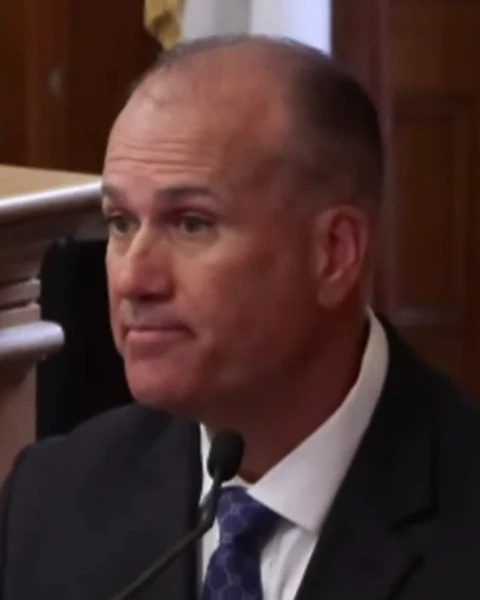
Paul Gallagher
Testimony Impact
Lt. Paul Gallagher served as a Canton Police Department officer who responded to the Fairview Road scene on January 29, 2022, where he processed the area with a leaf blower and collected blood evidence using red Solo cups borrowed from a neighbor. His testimony spans both trials, covering his initial scene response, evidence handling decisions, interactions with Brian Albert, and his role in the sallyport where Karen Read's SUV was stored. The defense used his testimony extensively to argue that evidence was mishandled, undocumented, and potentially contaminated before state police could process it.
Trial 1 vs Trial 2
In Trial 2, Gallagher's cross-examination was substantially extended, spanning parts of two days, and introduced additional lines of challenge not prominent in Trial 1 — including his failure to obtain Arlo camera footage from a neighbor, his decision not to seek a search warrant for the Albert home, and his reliance on Sgt. Lank having gathered names of house occupants without verifying that those interviews were conducted. Jackson also used Gallagher's prior Trial 1 testimony directly as a source of impeachment, confronting him with prior statements about evidence storage and his investigative approach.
Notable Quotes From The Record
“Sergeant Goode told me he was responding to a scene where a body was found unconscious, possibly not breathing, in the snow. He stated his name was John O'Keefe. He was a Boston police officer who resided on Meadow Avenue.”
Establishes the initial notification and what was known at the time of response.
“It was a broken clear cocktail glass, and the pink spot was frozen or coagulated blood.”
Identifies the two key physical evidence items recovered from the scene where O'Keefe was found.
“They were located between the street and where Mr. O'Keefe was found.”
Footprints existed only between the road and O'Keefe's body — none between the body and the Albert house, relevant to how O'Keefe ended up on the lawn.
“I didn't observe any footprints at that time.”
Specifically regarding footprints between O'Keefe's location and the 34 Fairview residence — supports or undermines theories about O'Keefe entering the house.
“I didn't observe anybody ever come out of their house at that time.”
No residents of Fairview Road, including 34 Fairview occupants, came outside during police scene processing — relevant to the neighborhood's response to the police activity.
“I handled them to the scene.”
Gallagher's terse answer about Solo cup handling underscores the informal evidence procedures used.
“I would say the entire department.”
Gallagher concedes that all ~45 Canton PD personnel had access to the sallyport where Read's SUV sat for three days before state police processing.
“There was no conflict of interest. I said it was the appearance of a conflict of interest.”
Gallagher draws a distinction between actual and apparent conflict, which Jackson uses to question why Canton PD continued participating in the investigation.
“We did not want to go on any investigative interviews because one of our best investigators' name is Kevin Albert — he's the property owner's brother — and we didn't think it would be appropriate if we were on those interviews questioning his family members.”
Provides the specific reason for Canton PD's partial recusal — a named conflict of interest with Detective Kevin Albert
“The state police takes jurisdiction. They run the investigation. We assist them in any way we can.”
Frames Canton PD as subordinate to state police, deflecting criticism of their investigative decisions
“I'm sure it was being handled by a criminalist — it wasn't going to be any cross-contamination. I wasn't concerned about cross-contamination.”
Directly counters the cross-examination's focus on evidence integrity by asserting criminalist handling prevented contamination
“No probable cause.”
Gallagher's final answer — the stated reason no further investigation of 34 Fairview Road was pursued
“No. Nothing... Nothing... Nothing.”
Gallagher's repeated assertions that nothing appeared suspicious or out of place inside 34 Fairview during his visit.
“Since the state police were not responding, I decided to process the area where Mr. O'Keefe was found and try to find out why he had the medical episode he was having.”
Establishes that Canton PD processed the scene only because state police initially declined to respond.
“Because of the blood — the pink spots I thought might be blood — I thought a leaf blower would be the best method because I have seen it used to remove light layers of snow and it can be controlled.”
Explains the rationale behind the leaf blower decision, which was challenged extensively in Trial 1 cross-examination.
“I expected it to be John's DNA and I wasn't going to get a second chance at it. It was either collected or never have it.”
Justifies the urgency of evidence collection under deteriorating weather conditions.
“That we should recuse ourselves from any further investigative interviews... because our best detective — his name was Kevin Albert — and he was the brother of the homeowner, and I didn't want any potential bias, whether unconscious or subjective, to be perceived by the O'Keefe family.”
Prosecution preemptively addresses the conflict-of-interest issue that was a major defense theme in Trial 1.
“I didn't.”
Gallagher admits he never wrote any report about his extensive hands-on evidence collection at the scene.
“Could have, but didn't.”
Gallagher concedes he could have sent an officer to get proper swabs from Canton PD but chose not to.
“Yep. They hold liquid terrifically.”
Gallagher's response about Solo cups underscores the gap between his improvised methods and forensic standards.
“Specifically, no.”
Admits there is no documentation of which Solo cup's contents came from which specific location at the scene.
“I have never seen an evidence log.”
Final admission that no evidence log documents the blood samples' chain of custody between collection and transfer to state police.
“I know what that camera captures.”
Gallagher's justification for not securing Arlo surveillance footage — based on personal assumptions rather than actually reviewing the footage, which is now lost.
“You're absolutely going to get it. Yes.”
Gallagher agrees that DNA transfer is highly sensitive and easily accomplished through touch — supporting cross-contamination concerns given the unsealed evidence stored near the SUV.
“Correct. None of that was done with what we just saw.”
Gallagher concedes that standard evidence-sealing protocols were not followed for the biological evidence collected at the scene.
“Because I knew it wouldn't have captured anything. I also know that they're motion-activated cameras and he didn't have them on the street, because it's a busy street and the batteries would die very quickly if they captured the street.”
Gallagher's explanation for not seeking Kelleher's Owl camera footage — directly addresses Jackson's cross-examination implication that the footage was negligently lost
“No, that was — that was us. I guess you would call it spitballing on possibilities.”
Clarifies that fight speculation came from detectives brainstorming, not from any witness statement
“So, probable cause is a reasonable belief that a crime has been committed or evidence of a crime can be found in a specific location.”
Sets up the legal framework for why no search warrant was sought for the Albert home
“No, I had complete faith in the criminalist.”
Rebuts cross-contamination concerns about blood evidence stored near Read's SUV
“No one is ruled out. Nothing is ruled out. Correct. That's correct.”
Gallagher affirms the investigative principle Jackson then uses to highlight everything that was in fact ruled out without investigation.
“I would have to twist circumstances to have the right to search Brian Albert's house. We had no reason. And there's been no reason since.”
Gallagher's strongest defense of the no-warrant decision — asserts there was and remains no basis for a search warrant, invoking Brady/Giglio obligations.
“Not to this day.”
Gallagher's emphatic answer — extending through the present — is the prosecution's capstone response to Jackson's extensive cross-examination about the unsearched Albert home.
“Despite his words, we have page 83, line 21. We have page 122, line 14. We have page 124, line 14. These are the words of attorney Alessi on direct examination.”
Brennan directly contradicts Alessi's claim that the defense never raised DNA, citing specific transcript pages from Alessi's own direct examination of Russell.
Key Moments
- Gallagher described borrowing red Solo cups from neighbor Tom Kelleher to scoop up blood-stained snow from the scene — a procedure the defense characterized as far below professional standards for what would become a homicide investigation.
- He acknowledged that the blood evidence collected in the unsealed Solo cups was stored in a Stop & Shop grocery bag near the right rear portion of Karen Read's SUV in the Canton PD sallyport, and conceded under cross-examination that this arrangement posed a risk of cross-contamination.
- Gallagher confirmed that he wrote no report, took no notes, and made no diagrams of his work at the scene, and was not formally interviewed about his actions until long after the fact — a pattern the defense used to argue the evidence chain of custody was fundamentally compromised.
- He testified that he observed no footprints between O'Keefe's body and the 34 Fairview Road residence, and that no occupants of Fairview Road came outside during scene processing — details bearing on how O'Keefe ended up on the lawn.
- Under cross-examination in Trial 2, Gallagher acknowledged that he never sought a search warrant for the Albert home, never secured Arlo camera footage from a neighbor, and never formally interviewed Brian Albert — decisions Jackson pressed against the investigative principles Gallagher himself articulated on the stand.