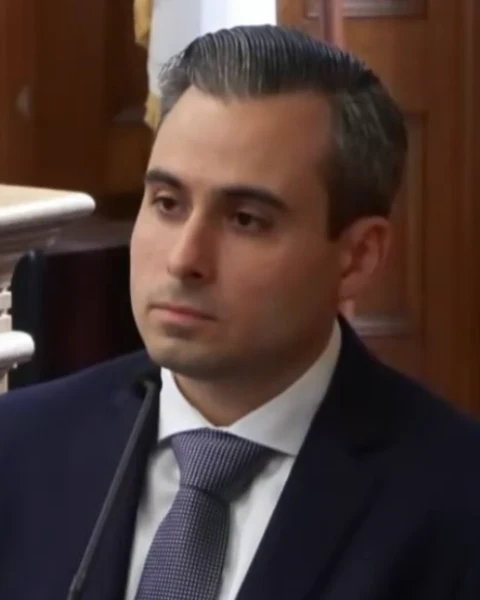
Matthew DiSogra
Also known as: DiSogra
Testimony Impact
Matthew DiSogra testified as a defense expert in Trial 2, appearing exclusively on Day 24. His testimony focused on reanalyzing the clock alignment work performed by prosecution experts Burgess and Welcher regarding the timing relationship between a Techstream vehicle event in Karen Read's Lexus and the last recorded movement of John O'Keefe's phone. DiSogra argued that when all possible clock offset scenarios from Burgess's own data are applied, the overwhelming majority show O'Keefe's phone lock event occurred after the vehicle event — a conclusion the defense presented as undermining the prosecution's timeline.
Notable Quotes From The Record
“The trigger is a singular point in time.”
Establishes that Dr. Welcher's characterization of the trigger event as lasting 5 seconds conflated the trigger with the recording window, adding 5 seconds of ambiguity to his timeline.
“He calculated all of them, but he didn't apply any of them.”
Key criticism of Burgess's methodology — he did the offset math but never completed the analysis by applying offsets to the event times.
“Regardless of what adjustment or combination of adjustments we make from the original reports, John's interaction window remains positive.”
Core conclusion from the January 2025 report analysis — every offset scenario shows the phone lock occurred after the vehicle event.
“25 of them are positive. John's interaction window is positive for 25 of them and only three were negative.”
Summary finding after incorporating the May 2025 supplemental report — 83% of all scenarios favor the defense timeline.
“Neither of the events that occurred on that date were triggered by a collision.”
Vehicle data shows no collision was recorded on January 29, 2022, supporting the defense theory.
“None of the prior events were triggered by a collision.”
Brennan immediately forced DiSogra to concede this statement is trivially true since Techstream never records collisions as triggers, neutralizing its jury impact.
“There's a minimum threshold to record in the EDR and a pedestrian impact generally wouldn't meet that.”
Concession that neither EDR nor Techstream data would necessarily capture a vehicle-pedestrian collision, limiting the defense's 'no collision data' argument.
“The data only tells us about the window of time the data captures. There's no way to know beyond that from the data.”
DiSogra admitted the 10-second Techstream window reveals nothing about what happened before or after, including a potential collision.
“Primarily, I wasn't asked to. So, I didn't do it. I wouldn't commission work without being asked to do it.”
Revealed he never wrote a report because defense counsel didn't request one, suggesting his role was narrowly directed by the defense team.
“I don't remember the context in which I used the word cherrypicking, but I don't think it was with respect to a trigger alignment.”
Walked back any implied criticism of Burgess's methodology, conceding the end-point alignment was equally valid.
“I don't know how the clocks are synchronized when you plug an iPhone into a car.”
Key concession undermining the foundation of his analysis — he built conclusions on data whose source behavior he cannot explain
“It's stated that way and I think it could be that way, but it might be iPhone to iPhone too, if those times are just copied over.”
DiSogra retreats from his position that the first five data points are infotainment-to-iPhone, acknowledging the alternative interpretation
“I don't think it is. I don't think there's one.”
Confirms no Techstream event for the known 5:07 a.m. bumping incident, demonstrating the data system's limitations for collision detection
“None of them were triggered by a collision.”
Reaffirms that no Techstream event in the vehicle's entire history was collision-triggered
“If the phone event moves from 12:32:09 to 12:32:16, then of the 30 possibilities I had in the chart, all of them would become positive. That would mean that that interaction occurs after the end of the vehicle event every single time.”
Demonstrates that later phone activity data strengthens the defense timeline from 25/30 to 30/30 scenarios
“Infotainment call timestamps.”
Reading Burgess's own column label directly undercuts Brennan's suggestion that DiSogra misidentified the data source
“I don't know.”
Concedes he cannot say whether the first five data points are based on the infotainment clock — the key ambiguity Brennan raised during cross
“I don't think the analysis was possible in this case because the testing wasn't done in this case.”
DiSogra's attempt to deflect backfires when Brennan reveals he never read Whiffin's report to know whether such testing existed
“I do not know.”
Final admission that DiSogra cannot account for O'Keefe's activity in the seconds immediately after the data window — walking, crawling, or falling
“Mr. Burgess's data and Dr. Welcher's data.”
Final answer of the examination — establishes that DiSogra's entire analysis was built on the prosecution's own experts' work.
Key Moments
- DiSogra presented a systematic reanalysis of Aperture LLC's clock alignment work, walking the jury through 30 possible offset scenarios derived from Burgess's own January 2025 report and May 2025 supplemental report, concluding that 25 of the 30 scenarios produced a positive interaction window — meaning O'Keefe's phone lock registered after the vehicle event in every scenario but three.
- DiSogra identified what he characterized as a critical methodology gap in Burgess's work: Burgess had calculated seven phone-call clock offsets in his January report but never applied any of them to his final analysis, a point DiSogra summarized by telling the jury 'He calculated all of them, but he didn't apply any of them.'
- DiSogra challenged Dr. Welcher's characterization of the Techstream trigger event, testifying that Welcher incorrectly treated the 5-second data recording window as the duration of the trigger itself, adding artificial ambiguity to the prosecution's timeline by conflating the trigger moment with the capture window.
- On cross-examination, prosecutor Hank Brennan methodically dismantled DiSogra's 'no collision' framing, eliciting the concession that Techstream does not record pedestrian impacts as triggers — making DiSogra's testimony that no collision events were found technically true but effectively meaningless as exculpatory evidence.
- Brennan further established that DiSogra had never written a formal report, reviewed no underlying raw data, conducted no independent testing, never examined the physical Lexus, and never spoke with Dr. Welcher — framing DiSogra's entire analysis as a derivative critique built entirely on other experts' outputs without independent verification.