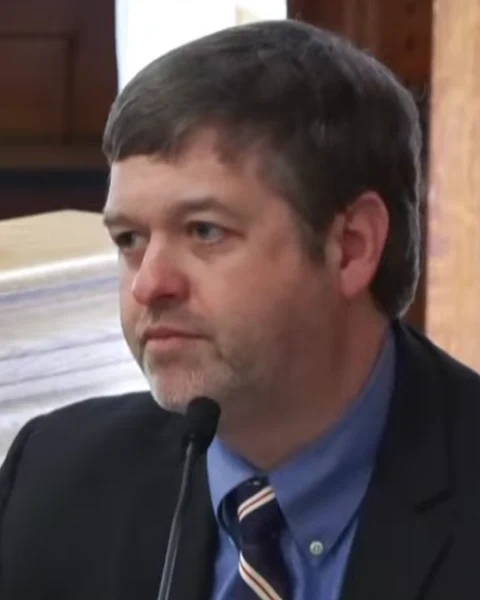
Justin Rice
Testimony Impact
Dr. Justin Rice is a board-certified emergency physician at Good Samaritan Medical Center who led the resuscitative efforts when John O'Keefe arrived in cardiac arrest with severe hypothermia on the morning of January 29, 2022. His testimony establishes the clinical details of O'Keefe's condition at the hospital — including a core temperature of 80.1°F, a Glasgow Coma Scale score of 3, and a 7mm laceration above the right eye — as well as the time of death. Rice also testified about Karen Read's simultaneous Section 12 admission and her blood alcohol level of 93 mg/dL measured that same morning.
Notable Quotes From The Record
“So it looks like, based on the code sheet, first line starting at 0647 — so I'll say 6:47 a.m.”
Establishes the precise time O'Keefe arrived at the emergency department.
“I see T equals 80.1 R. So I interpret that to be his temperature was 80.1 degrees by rectal temperature.”
Documents O'Keefe's severe hypothermia — 80.1°F is nearly 19 degrees below normal body temperature.
“According to my note, it looks like the time of death — the death declaration — was 7:50 in the morning.”
Establishes the official time of death after approximately one hour of resuscitative efforts.
“right superior orbital ridge region, approximately 7 mm laceration, and with surrounding soft tissue swelling / contusion.”
Documents the head injury observed by the ER physician — a laceration above the right eye with swelling.
“So it looks like 93.”
Karen Read's blood alcohol level of 93 mg/dL, measured the morning of O'Keefe's death.
“I can confidently say that I did not collect blood work — yeah, that I did not do that.”
Rice cannot identify who collected, packaged, or submitted Karen Read's blood to the lab, creating a chain-of-custody gap for a key piece of evidence.
“So — no, there is not. In fact, there's no mention of a vehicle whatsoever.”
After initially suggesting his report referenced a possible vehicle strike per EMS, Rice conceded upon reviewing the actual document that no vehicle was mentioned at all.
“No, I did not. I'd be happy to explain that, but to answer your question, no, I did not.”
Rice acknowledged no fractures were reported while signaling there may be clinical reasons, but Little cut off further explanation.
“the focus is in core resuscitative medicine: securing an airway, making sure he has a breathing tube in, making sure that the CPR is being applied at the right pressure to the right place, making sure that the core resuscitative elements of medicine are happening.”
Explains why the ER team did not conduct a full injury assessment — resuscitation took priority over documentation of non-life-threatening injuries.
“Unless there was an extremity injury that would be pertinent to his resuscitation — if he had had a traumatic amputation, as in removal of a leg for example, that would be pertinent to a resuscitation. But an otherwise intact extremity, you know, that is not necessarily within the realm of resuscitation.”
Clarifies the threshold for documenting extremity injuries during cardiac arrest — only injuries affecting resuscitation efforts would be noted.
“clinical impression — cardiac arrest, trauma, head trauma, exposure to environmental cold.”
Rice's contemporaneous clinical impression included both trauma and head trauma alongside hypothermia, documenting injury at the time of treatment.
Key Moments
- Rice documented O'Keefe's arrival at 6:47 a.m. in full cardiac arrest with a rectal temperature of 80.1°F — nearly 19 degrees below normal — establishing the severe hypothermia that complicated resuscitation efforts over the next hour before his death was declared at 7:50 a.m.
- On direct, Rice described the only documented injury on O'Keefe's body: a 7mm laceration on the right superior orbital ridge with surrounding soft tissue swelling and contusion, along with abrasions on the right forearm — a limited injury profile that became central to the defense's cross-examination.
- During cross-examination by Elizabeth Little, Rice methodically confirmed that O'Keefe had no documented fractures or broken bones anywhere from the neck down, with his injuries limited to the eye laceration and forearm abrasions — an inventory the defense used to argue O'Keefe's injuries were inconsistent with being struck by a vehicle.
- Rice initially suggested that EMS may have reported a possible vehicle strike, but after reviewing his own report on the stand, he conceded there was no mention of a vehicle whatsoever in his documentation.
- On the question of Karen Read's blood draw, Rice acknowledged he did not collect, package, or submit her blood to the lab, and could not identify who did — leaving a chain-of-custody gap for a key piece of prosecution evidence.