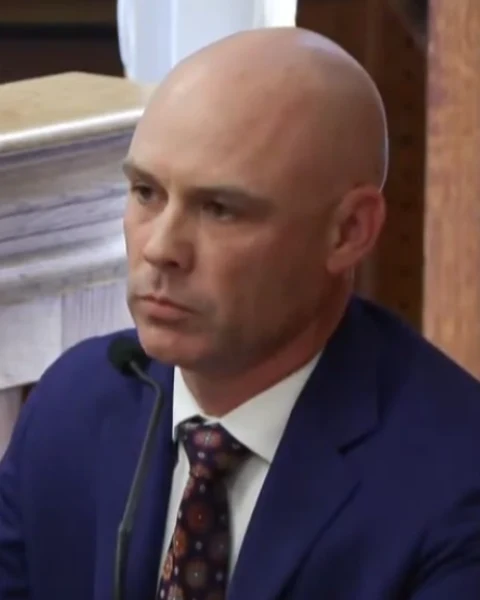
Joseph Paul
Testimony Impact
Trooper Joseph Paul is a Massachusetts State Police crash reconstructionist assigned to the CARS unit who analyzed vehicle data, physical evidence, and the scene at 34 Fairview Road. He testified across two days in Trial 1, presenting EDR and VCH data from Read's Lexus LX 570 to support the prosecution's theory that the vehicle struck O'Keefe during a reverse maneuver. His testimony encompassed vehicle inspection findings, data module downloads, geographic mapping of triggering events, and a formal collision reconstruction opinion placing the vehicle at the scene at the time of impact.
Notable Quotes From The Record
“74.5 starts at 8 seconds.”
Establishes that near-maximum throttle pressure (three-quarters down) was applied during the reverse acceleration, suggesting forceful rather than casual operation.
“So this one shows that the vehicle was in drive — it starts off in drive, it's slowing down to zero, and it goes to zero, which is neutral, then it goes down, then it goes into reverse. So it's going straight, it stops, and it gets placed in reverse, and then it goes back — goes in reverse.”
Describes the vehicle's shift sequence in the 12,629-B event — drive to stop to reverse — establishing the prosecution's theory of the vehicle's movements.
“There's a point there where it appears to be consistent with a pedestrian strike.”
Paul's core opinion connecting the VCH data to a pedestrian collision — the central conclusion of his reconstruction analysis.
“Everything seemed to be working properly.”
Confirms the vehicle's backup cameras, 360-degree overhead view, and proximity sensors with audible beeping were all functional — undermining any defense claim that the driver could not have seen a pedestrian behind the vehicle.
“It's the sudden change of speed — that 24.2 to 23.6 in a half second — while the accelerator pedal is still at a consistent 74%, and also the steering wheel angle goes left at 4.5 degrees and also goes right to 4.5 degrees, and then goes back to left after that.”
Explains the specific data points that led Paul to conclude the VCH event is consistent with striking a pedestrian — speed drop with sustained throttle and steering perturbation.
“the tail light is, what I'd say, 42 to 50 inches off the ground, so that vehicle would have to have damage 42 to 50 inches off the ground, because they would have had to contact each other at the same distance from the ground, and there's no — there's no damage to that vehicle.”
Core of Paul's opinion — the geometric mismatch between taillight height and lack of damage on O'Keefe's Traverse
“Maybe like one, two miles per hour.”
Paul's estimate of the contact speed, which Jackson uses to argue this is outside Paul's normal investigation experience of fatal crashes
“I watched it the first time on Court TV.”
Reveals Paul first saw the Ring video not during his investigation but on television, undermining the rigor of his analysis
“It should occur probably on Fairview.”
Paul places the 24.2 mph reverse event specifically on Fairview Road based on odometer analysis, linking the EDR data to the crash location.
“The vehicle traveled up to 24 miles per hour and approximately 62 feet.”
Quantifies the speed and distance of the reverse travel, drawn from the EDR data presented on Day 25.
“The right rear of the Lexus struck the pedestrian John O'Keefe.”
The expert's central conclusion identifying the specific part of the vehicle and the mechanism of injury.
“Mr. O'Keefe was projected forward and to the left along the front yard of 34 Fairview Road.”
Describes the post-impact trajectory, connecting the collision reconstruction to the physical scene evidence (final rest position, shoe, debris).
“There were no mechanical defects.”
Eliminates vehicle malfunction as a contributing factor, reinforcing that the collision was caused by operator conduct.
“I don't know the exact point of impact.”
After extensive questioning, Paul concedes he cannot identify the specific area of impact — a foundational element of his reconstruction.
“There was no evidence that he landed or rolled.”
Undermines Paul's 'projected forward' theory — no physical evidence supports how O'Keefe traveled 30 feet from the alleged point of impact to his final resting place.
“It just — it just did.”
Paul's response when asked how O'Keefe's cell phone ended up under his body after being projected 30 feet, highlighting the absence of a scientific explanation.
“We cannot calculate anything from this collision.”
The prosecution's own reconstruction expert admits he cannot perform the physics calculations to verify his 30-foot projection theory.
“Why I think that's consistent with a pedestrian strike is because of the sudden change in the speed — it drops down by half a mile per hour, the accelerator pedal is staying constant at the same percentage, and the steering wheel angle also turns to the right.”
Re-establishes Paul's core opinion linking the EDR speed drop to a pedestrian impact after cross challenged the interpretation.
“I do not have any evidence that he would have flown 30 feet in the air.”
Directly counters the defense implication that Paul's theory requires O'Keefe to fly 30 feet, reframing the post-impact movement as rotation and ground travel.
“I would say the odometer mileage... you can physically see it when you turn the car on, and I know that's the odometer mileage that it's reading on the dashboard.”
Counters Jackson's key-cycle hypothetical by establishing odometer readings as independently verifiable and more reliable for placing the vehicle at the scene.
“The tail light appears to be broken with sharp plastic pieces that could have ripped his arm, and also the dent with the scratches above it is consistent with a hand holding a glass and the glass on top smashing on the vehicle, and the hand smashing the vehicle.”
Paul's most specific testimony connecting physical vehicle damage to O'Keefe's injuries and the glass he was carrying — tying multiple evidence points together.
“I don't — so in your hypothetical, I mean, assume that it should create a key cycle, but you can't just say that key cycle is from that, because I didn't just use key cycles — I use the odometer mileage on top of it. So you have to have key cycle and odometer.”
Paul shifts emphasis to odometer mileage as corroboration after Jackson's cross exposed key cycle vulnerabilities
“that would mean — that would be — that the vehicle would already be in Massachusetts State Police custody —”
Paul begins to concede that certain mileage scenarios would place the triggering events during law enforcement custody rather than the alleged collision, before the judge cuts him off
“Yes.”
Paul's final word to the jury is an unqualified confirmation that his reconstruction places the defendant's vehicle at the scene for both triggering events.
Key Moments
- Paul presented the prosecution's central technical argument: that a VCH event recorded in Read's Lexus — a sudden speed drop from 24.2 to 23.6 mph in half a second while throttle held steady at 74% during reverse — is consistent with striking a pedestrian, and that the vehicle traveled approximately 62 feet in reverse at 24 mph before that event.
- Paul confirmed that Read's Lexus had a fully functional backup camera, 360-degree overhead view system, and proximity sensors with audible alerts at the time of the incident, undercutting any suggestion the driver lacked visibility of objects behind the vehicle.
- During a voir dire hearing, Jackson established that Paul first viewed the Ring video on Court TV rather than during his investigation, that he developed a new opinion about taillight geometry and the O'Keefe Traverse just two weeks before trial, and that no supplemental report disclosing this opinion had been provided to the defense — raising a potential discovery issue.
- On cross-examination, Jackson confronted Paul with a piece of taillight debris found near a fire hydrant that Paul had not accounted for in his analysis, forcing Paul to repeatedly acknowledge he was unaware of it, and introduced evidence suggesting Paul's key-cycle-based geographic placement of the vehicle at 34 Fairview Road was undermined by an alternate route of travel.
- During recross, Jackson pressed Paul on an apparent shift in his reasoning between direct examination and cross — where Paul had emphasized key cycle counting on direct but on cross retreated to odometer mileage as the 'dominant reason' for placing the vehicle at the scene — with Jackson arguing that if the assumed route of travel was wrong, the entire odometer-based analysis would collapse.