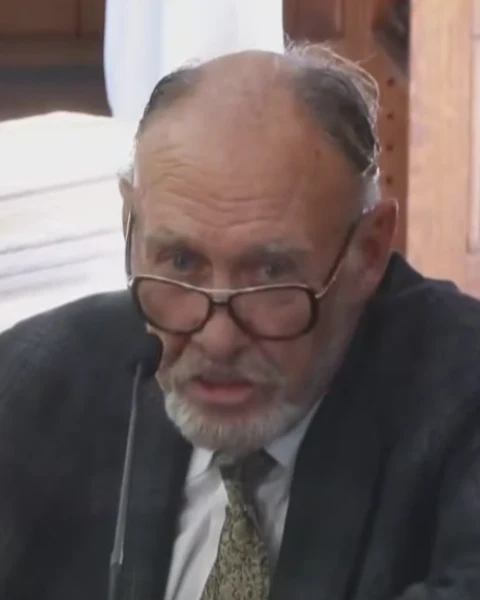
Frank Sheridan
Testimony Impact
Dr. Frank Sheridan is a forensic pathologist retained by the defense in Trial 1 who testified on Day 30. Working from photographs and reports rather than direct examination of the body, Sheridan offered opinions on O'Keefe's injuries that supported the defense theory: that the arm wounds reflected a dog attack rather than vehicle contact, and that the fatal head injury would have caused immediate unconsciousness, meaning O'Keefe could not have moved after sustaining it. His testimony was confined to a single day covering direct examination, cross-examination, and a brief redirect.
Notable Quotes From The Record
“If you mean struck in that part of the body, on the arm — directly — I would say no, it doesn't look like that at all.”
Direct expert rejection of the prosecution's vehicle-strike theory for the arm injuries.
“my initial reaction when I saw this photograph was that it was probably an animal mark, and most likely I would say a dog — scrape marks with the paw, and possibly also a bite mark from the teeth as well”
Expert opinion supporting the defense theory that a dog caused the arm injuries.
“Once this impact occurred — Mr. O'Keefe would have been unconscious. He would still be capable of breathing for a while, until that brain swelling took over and pushed the brain stem down. But he would immediately — immediately, from the point of impact — he would have been unconscious for sure.”
Establishes that O'Keefe could not have moved or stood after sustaining the head injury.
“the head injury, the major head injury I've described — but he also had a laceration over his right eyelid. He had some scrape marks on his face. He also had some bruises on the back of his right hand, which — that kind of injury on the hands can be what we call a defensive injury”
Expert characterizes hand bruising as potential defensive injuries, supporting the altercation theory.
“They don't look remotely like that to me.”
Sheridan maintains his position that arm injuries could not have come from vehicle interaction, despite conceding multiple gaps in his knowledge.
“If all that happened, yes. And onto asphalt or something like that, yes. If that's indeed what happened — but for other reasons, I don't think that is what happened.”
Sheridan concedes that vehicle projection onto a hard surface could cause O'Keefe's skull fracture, qualifying his disagreement as opinion-based rather than mechanical impossibility.
“Not that I'm aware of, no.”
Final concession that no evidence in any materials he reviewed showed the dog interacting with O'Keefe.
“It shows the deceased's knees taken from the right side, but you can see both knees.”
Describes the photograph being entered as Exhibit 657
“Yes. This has been mentioned before. It's an abrasion, and that's the extent of the injury to Mr. O'Keefe -- correct. Yeah, that's it, yeah, in that area.”
Sheridan characterizes the knee injury as merely an abrasion, minimizing its significance as evidence of a vehicle strike
Key Moments
- Sheridan testified that O'Keefe's arm injuries showed no characteristics consistent with being struck by a vehicle, and that his initial reaction upon seeing photographs was that the marks were animal-related — most likely dog claw and scrape marks.
- On the fatal head injury, Sheridan stated that upon impact O'Keefe would have been rendered immediately unconscious and incapable of movement, though capable of continued breathing until brain swelling progressed — testimony central to the defense's argument that O'Keefe could not have been struck and then walked or fallen elsewhere.
- During cross-examination, prosecutor Lally confronted Sheridan with UC Davis forensic testing results showing no canine DNA was found on O'Keefe's sleeve in the area of the arm injuries — evidence Sheridan acknowledged he had not been provided and was unaware of, directly challenging the foundation of his animal-attack opinion.
- Lally established that Sheridan had never performed the autopsy, never examined the body in person, and had not reviewed several pieces of prosecution evidence including taillight fragment analysis — a series of concessions that framed his opinions as based on an incomplete evidentiary record.
- On redirect, the defense introduced a photograph of O'Keefe's knee injury as Exhibit 657, with Sheridan characterizing it as merely an abrasion, countering any suggestion that the knee wound indicated a vehicle strike.