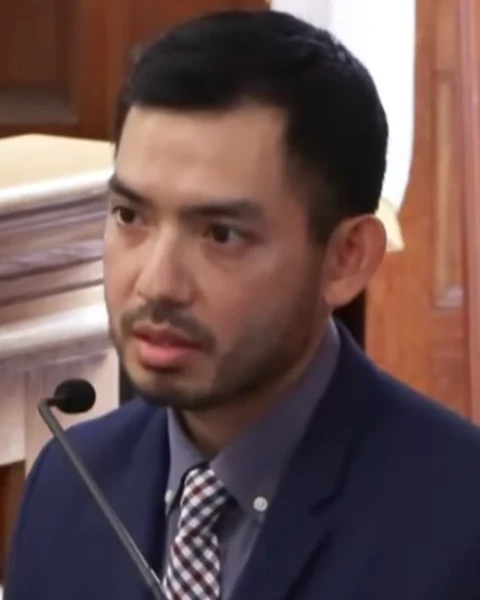
Carl Miyasako
Testimony Impact
Carl Miyasako is a DNA analyst employed by Bode Technology who conducted mitochondrial DNA analysis on a hair sample recovered from the rear panel of Karen Read's vehicle. Called by the prosecution in Trial 2, he testified that the hair was consistent with John O'Keefe's mitochondrial DNA profile, with 99.895% of the population excludable as the source at 95% confidence. His testimony on Day 18 covered the methodology, statistical conclusions, and inherent limitations of mitochondrial DNA testing as compared to autosomal STR analysis.
Notable Quotes From The Record
“for hair samples, typically in the shaft end, there's more abundance of the mitochondrial DNA versus nuclear DNA, where nuclear DNA tends to be degraded or not present in high enough amounts”
Explains why mitochondrial rather than autosomal DNA testing was used on this hair sample
“with 95% confidence, at least 99.895% of the population can be excluded as being a source of the hair sample”
The core statistical conclusion linking the hair evidence to O'Keefe
“with 95% confidence, 99.985% of the population could be excluded. However, with John O'Keefe and his maternal relatives, they could not.”
Clarifies the narrow pool of people who cannot be excluded — only O'Keefe and maternal relatives
“With mitochondrial DNA analysis, it's not unique to an individual. Um, compared to traditional STRs, or short tandem repeat, that could be unique to an individual. But with mitochondrial DNA, it's not unique to an individual, but more so a maternal lineage.”
The witness concedes the fundamental limitation of the test — it cannot identify a specific person.
“I can't say whether it is, but the profile obtained from John O'Keefe is consistent with that hair sample.”
Shows Miyasako's careful phrasing — consistent with, but not identified as O'Keefe's.
“I could not — could not exclude John O'Keefe's known standard's profile being consistent... with the hair sample's profile, and with 95% confidence, at least 99.895% of the population can be excluded as a source of the evidence.”
The prosecution's core forensic conclusion restated for the jury after cross-examination.
“With the maternal populations, I can't exclude anybody maternally related to John O'Keefe as well.”
Even on redirect, the witness reiterates the limitation Jackson established on cross — the hair could belong to any maternal relative.
Key Moments
- On direct examination, Miyasako presented the prosecution's central forensic conclusion: that with 95% confidence, at least 99.895% of the general population could be excluded as the source of the hair, leaving only O'Keefe and his maternal relatives within the possible pool.
- Miyasako explained that mitochondrial DNA was used rather than standard autosomal testing because hair shaft samples — unlike root samples — typically lack sufficient nuclear DNA for STR analysis, making mitochondrial sequencing the appropriate methodology.
- On cross-examination, Jackson elicited a series of concessions that effectively reframed the evidence: Miyasako acknowledged that mitochondrial DNA cannot identify a specific individual, that O'Keefe's mother, maternal nephew, and any other maternal relative would produce an identical result, and that the analysis cannot determine how or when the hair came to be on the vehicle.
- The cross-examination's most pointed moment came when Jackson established directly that Miyasako could not tell the jury how the hair got to where it was found — a gap central to the defense's argument that the hair's presence on the car does not establish contact during an impact.
- On redirect, Lally had Miyasako restate the exclusion statistic and reaffirm his conclusion, but the witness also reiterated the maternal-line limitation — conceding again that O'Keefe's maternal relatives could not be excluded — leaving both the prosecution's statistical framing and the defense's individualization challenge before the jury simultaneously.