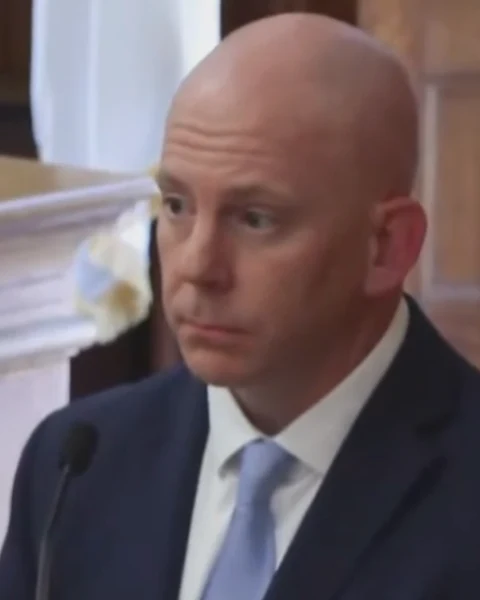
Brian Tully
Testimony Impact
Det. Lt. Brian Tully of the MSP led the state police investigation into John O'Keefe's death and was the prosecution's primary witness for the investigative record. His testimony spanned two days in Trial 1, covering the January 29 search of the Fairview Road snowbank, the decision to exclude Canton Police due to conflicts of interest, and the cell site location data and surveillance video placing Read's vehicle near 34 Fairview Road in the early morning hours. He also addressed the investigation's decision not to search the interior of the Albert home.
Notable Quotes From The Record
“That determination by the OCME is often in the early stages of investigation, and as we learn more information the circumstances can change. And the determination that is made by the medical examiner, that's strictly from a medical perspective.”
Prosecution establishing that an undetermined manner of death from the ME does not preclude criminal charges based on the totality of the investigation.
“Because of the appearance of a conflict, we had made a decision that the Canton Police was going to take a step back from the investigation and that the state police would do the investigation without them.”
Acknowledges the conflict of interest created by the homeowner at 34 Fairview being connected to Canton PD, and documents the decision to limit Canton's role.
“I had a long discussion with him about the content and nature of them. I expressed my displeasure at the unprofessionalism and the content of them, and then I reported up my chain of command.”
Tully's response to Trooper Proctor's inappropriate text messages — prosecution preemptively addressing the misconduct issue before cross-examination.
“They were in total within a five-foot area. So if you're looking at the house from right to left, that was how they were found.”
Establishes the physical proximity of the recovered evidence items to each other at the scene.
“I didn't have any. When thinking about residences and search warrants and evidence, I need to put the evidence inside the house. And so I don't believe that Mr. O'Keefe entered the home, so I had no nexus to the house.”
Explains the prosecution's rationale for never searching inside 34 Fairview Road — a central point of the defense's conspiracy theory.
“Starting at 12:33 a.m. to 6:03 a.m., there were 53 phone calls from Ms. Read to a phone number associated with John O'Keefe.”
Establishes the volume of unanswered calls Read made to O'Keefe's phone throughout the night.
“It would take you much quicker to get there. It's about a mile and a half from Temple Beth Abraham to Country Lane.”
Highlights a timing gap — Read's vehicle passed the temple at 5:18 a.m. but didn't arrive at McCabe's until 5:35, raising the question of where she went during those 17 minutes.
“That SUV is similar to the defendant's. And with this record here, a phone associated with the defendant was somewhere on this arc at that exact same time.”
Tully ties together the surveillance video and cell tower ranging data as corroborating evidence of Read's location.
“I will take the hit that my report does not properly memorialize it, but I would argue that the handwritten notes on the bag that are contemporaneous to the collection of the evidence would be more accurate.”
Tully concedes his official report is inaccurate on the number of plastic pieces recovered — undermining the integrity of evidence documentation.
“The bags were, you know, out of our custody at the crime lab for a period of time.”
Tully acknowledges the evidence bags were out of police custody, raising chain-of-custody questions about the unexplained additional plastic pieces.
“135,000.”
Tully performs the calculation himself confirming the RTT data would require 135,000 mph travel speed — demonstrating the physical impossibility of the prosecution's ranging interpretation.
“The first was that this person saw a Ford Edge in front of 34 Fairview. The next one that I can recall is that the person stated that they were not on Fairview but on Cedarcrest, some distance away, looking at this vehicle — in a blizzard. The person also self-reported that he was color blind, and he was operating a larger motor vehicle.”
Tully lays out the inconsistencies in the Ford Edge witness's accounts to justify not pursuing that lead
“It's suggestive in the fact that it would be a single photo identification, which — you know, as a police officer — I would not give somebody one thing and be suggestive, 'Is this it?' — because, as the courts have ruled, that's highly suggestive”
Tully uses police procedure standards to discredit the Ford Edge identification method
“The pieces of evidence were physically on the roadway, on the pavement or curb.”
Positions the recovered taillight evidence closer to the street than to the house, supporting a vehicle-strike theory over evidence being carried from inside
“While I agree it would be impossible for the phone to travel at that distance, I disagree with the premise that the procedure that was being captured here — and the distances — may not be at the same time.”
Tully's rebuttal to Jackson's 135,000 mph calculation — the two data points may not represent simultaneous positions
“I will suggest to you that it is probably unbelievable that those are actually start and end times.”
Tully concedes the data fields may not mean what the labels suggest, undermining the foundation of his arc map analysis.
“I don't have them in front of me.”
Tully admits he lacks the documentation needed to definitively explain the RTT data fields he relied on for his maps.
Key Moments
- Tully explained that Canton Police were removed from the investigation because the homeowner at 34 Fairview Road, Brian Albert, had connections to Canton PD — a conflict the MSP acknowledged and acted on before the investigation concluded.
- On the January 29 snowbank search, Tully described the recovery of taillight pieces and John O'Keefe's missing shoe within a five-foot area, physical proximity the prosecution used to anchor its vehicle-impact theory.
- Tully walked the jury through cell tower ranging data and surveillance footage showing a black SUV — consistent with Read's Lexus — near the Albert house at 12:15, 12:27, 5:11, 5:15, and 5:18 a.m., and noted that Read made 53 unanswered calls to O'Keefe's phone between 12:33 a.m. and 6:03 a.m.
- On cross, Tully conceded that his official report stated three pieces of plastic were recovered when the evidence bag handwritten notes indicated a different count — an inconsistency he acknowledged but defended by pointing to the contemporaneous bag labeling.
- Jackson pressed Tully on the RTT ranging data used to generate the cell tower arc maps, demonstrating through arithmetic that the arcs as drawn implied a vehicle speed of 135,000 mph — and that Tully lacked the Verizon records key needed to interpret the underlying data fields.