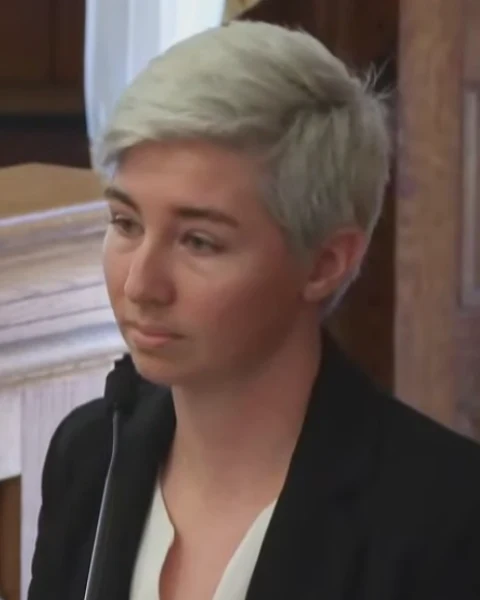
Ashley Vallier
Testimony Impact
Ashley Vallier is a forensic scientist with the MSP Crime Lab who conducted physical match analysis of plastic and glass fragments recovered from 34 Fairview Road, the scene where John O'Keefe's body was found. Using a stereo zoom microscope, she assembled dozens of individual debris fragments into five composite groupings and determined that one of those groupings mechanically fit the tail light housing from Read's Lexus LX 570. She testified in both trials, presenting the same core forensic conclusion while facing cross-examination focused on the chain of custody timeline for the evidence Trooper Proctor delivered to the lab.
Trial 1 vs Trial 2
Vallier's testimony was substantively consistent across both trials, covering the same physical match methodology and the same central conclusion. The Trial 2 examination was more compressed, consolidating into a single day what had taken parts of two days in Trial 1. Yannetti's cross-examination in Trial 2 maintained the same chain-of-custody focus — the six-week delay and the pattern of Proctor's successive collections — without introducing new lines of attack, reflecting the defense's continued reliance on the evidentiary timeline as their primary challenge to this testimony.
Notable Quotes From The Record
“Physical match analysis is looking at two or more items that have broken or irregular edges and seeing if they fit together — sort of like a jigsaw puzzle.”
Plainly defines the forensic methodology for the jury.
“Piece one was a physical match with item 3-1, the tail light.”
The central forensic conclusion — fragments from the road matched the tail light housing, linking vehicle damage to the scene.
“So from those items that we just saw, I was able to piece one larger piece — many of those pieces all fit together into one piece that I then called piece one. There are some other pieces that also fit together among those, which I called piece two, piece three, piece four, and piece five.”
Shows the scope of the reconstruction — multiple fragment groupings assembled from the road debris.
“I did this by color, because it seemed the easiest way to organize all of these pieces.”
Describes her organizational methodology for handling dozens of fragments across multiple evidence items
“So when things break, they break in a unique pattern — it's pretty different every time. So a mechanical fit is bringing two things with broken edges together to see if they were originally part of the same item — to see if the broken edges align. And if they do, then that's a mechanical fit.”
Explains the scientific basis of physical match analysis for the jury
“So before even comparing to the tail light, I compared all of the questioned items to each other — so that's items 7-5 to 7-19 — to see if any of those pieces would fit together. And amongst those I was able to make five larger pieces that I called piece one through piece five.”
Establishes the systematic bottom-up approach — fragments assembled into five composite pieces before comparison to the known tail light
“That item 3-1 and the pieces that make up piece one were at one time together as a larger unit.”
The key conclusion — scene debris physically matches the tail light housing, placing the vehicle at the scene of injury
“I mean, it's longer than the ruler. Okay, yeah.”
Concedes the large size of pieces found weeks later, supporting the implication that they should have been found earlier
“I do not.”
Confirms she cannot account for the missing section of the reconstructed tail light, leaving an open question about the evidence
“Maureen Hartnett.”
Identifies who transferred the clothing debris to Vallier's unit, addressing the chain-of-custody question raised on cross.
“So visually, I take overall pictures of the debris, and then I'll look through the stereo zoom to see if there's any— anything that looks different, and then I'll take a picture of that.”
Reinforces the rigor of her microscopic examination methodology for the tiny debris fragments.
“So physical match analysis is piecing broken things together to see if they were at once a single item.”
Defines the core methodology for the jury in plain terms.
“The questioned items were items labeled as coming from a road and the known item was labeled as coming from a tail light from a vehicle.”
Frames the two categories of evidence being compared — road debris versus the defendant's tail light.
“Mechanical fit and a physical match are the same thing. It's when the broken edges align together to show that they were once a single item.”
Establishes the scientific standard for concluding fragments originated from the same object.
“Two pieces from item 7-15, F and H, fit mechanically with two pieces from item 7-16, F and G.”
Demonstrates cross-item matching between separately collected evidence bags.
“So two pieces from item 7-5, four pieces from item 7-8, one piece from item 7-10, four pieces from item 7-11, two pieces from item 7-12, two pieces from item 7-13, four pieces from item 7-15, and four pieces from item 7-16 were found to fit mechanically with item 3-1.”
The central finding — fragments from eight separate evidence items all fit the defendant's tail light housing.
“Those pieces were once together as part of a larger unit.”
Vallier's conclusion that all matched fragments and the tail light were originally one piece.
“The piece of apparent clear plastic was approximately 1/8 inch by 1/16th inch.”
Establishes physical debris from the tail light was found on John O'Keefe's clothing.
“There was an empty spot on the overall reconstruction. Yes.”
Confirms a missing section of the tail light was never recovered or provided for analysis.
“Submission seven — all the items that are seven dash — was submitted by Trooper Michael Proctor.”
Establishes Proctor as the sole handler who delivered all disputed evidence items to the lab.
“March 14th, 2022.”
Pins the six-week gap between the incident and lab submission — the core of the chain of custody challenge.
“As far as all those items beginning with seven that you went through or elucidated on in your direct examination, each of those were a mechanical fit to each other and then to the tail light housing in 3-1.”
Reaffirms the central forensic conclusion — all debris items mechanically fit the defendant's tail light housing.
Key Moments
- Vallier explained physical match analysis to the jury using the analogy of a jigsaw puzzle — broken edges are unique enough that a fit between two pieces establishes they were once part of the same object — establishing the scientific foundation for her conclusion before presenting her results.
- Her central finding, that the fragments she labeled 'piece one' physically matched item 3-1, the tail light housing from Read's vehicle, was the prosecution's primary forensic link placing Read's car at the scene of O'Keefe's death.
- Vallier described her systematic methodology: she first compared all questioned debris items to each other, assembling them into five composite pieces, before comparing any of them to the known tail light housing — a bottom-up approach she walked the jury through step by step over two days of direct examination.
- On cross-examination in both trials, Yannetti used Vallier's own evidence records to establish a timeline showing that Trooper Proctor collected progressively larger plastic fragments over a period of weeks after the initial discovery — including pieces too large, Yannetti suggested, to have been missed in earlier searches — and that all of these items sat undelivered to the crime lab for six weeks.
- Vallier acknowledged on cross that she had no knowledge of what Proctor did or did not do with the evidence bags between the time of collection and his March 14, 2022 delivery to the lab, and that she had never directly examined the clothing items — a concession that grounded the defense's chain-of-custody challenge in Vallier's own testimony.