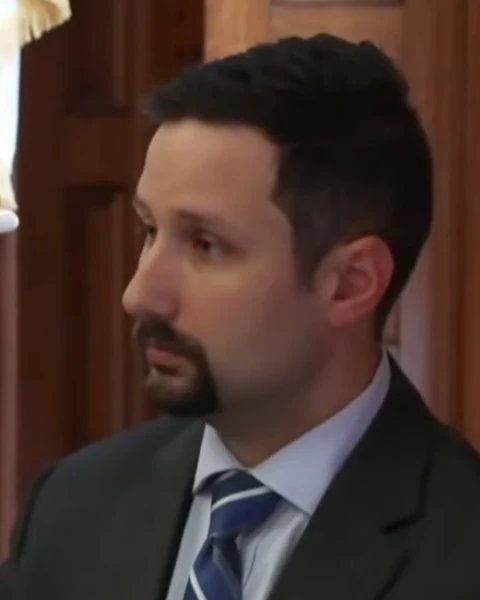
Anthony Flematti
Also known as: Flatley
Testimony Impact
Anthony Flematti is a Canton Fire Department firefighter and paramedic who responded to the 6:06 AM emergency dispatch to 34 Fairview Road during the January 29, 2022 snowstorm. As the lead paramedic on scene, he assessed and treated John O'Keefe, who was found unresponsive and buried to mid-chest in snow. Flematti's testimony in Trial 1 centered on two key areas: his clinical observations of O'Keefe's condition and injuries, and Karen Read's repeated statement — 'I hit him, I hit him, oh my God, I hit him' — which he relayed as a potential explanation for O'Keefe's injuries. His account was subjected to detailed cross-examination over the absence of that statement from his written paramedic report.
Notable Quotes From The Record
“So visibility was extremely poor. Um, high winds, probably 20–30 mph winds, temperature probably in the 20s, with uh still actively snowing at that time.”
Establishes the extreme weather conditions the victim was exposed to overnight.
“Sun had not come up yet. It was still dark, heavy winds, heavy snow, so visibility was almost zero.”
Confirms pre-dawn darkness compounded by storm conditions at time of response.
“So we have our dispatch time 6:06, en route time 6:07, on scene 6:14, at patient 6:15, and we had transported from that scene at 6:27 and arrived at destination — at the hospital — 6:45.”
Establishes the precise EMS timeline from dispatch through hospital arrival.
“So as we're pulling up to the scene, we see two female parties — non-uniform personnel — that were going back and forth between the body and the side of the street, back and forth. Looked like — appeared to be a female party that was pushing on his chest and then going back and forth between the other female party and the patient.”
First responder's initial observation of the scene — two women present, one performing chest compressions on the victim.
“So snow was probably up to the mid-axillary point, so we're looking at probably halfway up his rib cage. Top of his body was clear.”
Establishes how much snow had accumulated on O'Keefe, relevant to how long he was exposed and weather severity.
“If it would have been removed, both of them would have been removed, to assess that. It wouldn't do much good to just remove one and leave it there on scene.”
Establishes that first responders did not remove O'Keefe's missing shoe, meaning it was already gone before they arrived.
“So the only response that I was personally given was just, "I hit him, I hit him, oh my God, I hit him."”
Karen Read's statement to the first responder, offered as a potential admission of striking O'Keefe with her vehicle.
“She just repeated the phrase over and over again: "I hit him, I hit him."”
Establishes that Read provided no other explanation or context — only the repeated phrase.
“We had active bleeding from other areas in the body. So the fact that it had already stopped and clotted, I would assume that would have been several hours before the incident that led him to be there.”
Flematti's medical opinion that the dried arm lacerations predated O'Keefe's time in the snow, suggesting a timeline of injury before exposure.
“It wasn't productive.”
Flematti's own characterization of his conversation with Read — undermining the idea it yielded a clear, detailed admission.
“I recall telling the doctors and nurses that there's a question of that — the patient was hit by a vehicle, or 'we don't know,' is what I directly said to the doctors and nurses.”
A new claim raised for the first time at trial — never documented in reports, police interviews, or grand jury testimony.
“Doesn't say that.”
Flematti's repeated admission that his report contains no mention of Read's alleged statement, no mention of telling hospital staff, and no mention of concern about a vehicle strike.
“It's actually recommended not to.”
Addresses the CPR duration point from cross — the two-minute rotation protocol means multiple responders would have cycled through compressions, contextualizing the dashcam video timeline.
“So it was due to the proximity of the patient to the roadway and the vagueness of the statement. So, proximity to the roadway and the fact that she stated "I hit him," the red flag of him being underdressed — and people don't just lie down in the snow in a blizzard — so how he got there we're not sure, so we're trying to figure out what happened. But due to the proximity of the roadway, that was our first inclination.”
Flematti articulates the clinical reasoning behind relaying a motor vehicle scenario to the hospital — the prosecution's key rehabilitation of his challenged testimony about informing hospital staff.
“I don't recall if I asked her specifically about that.”
Flematti retreats from certainty, unable to confirm he ever raised the possibility of a car strike with Read.
“So I left it open-ended to the staff of the hospital that these are both possibilities of what happened to the patient.”
Flematti reframes his hospital communication as presenting multiple possibilities rather than a definitive vehicle-strike report.
Key Moments
- Flematti described arriving at the scene in pre-dawn darkness during a heavy snowstorm with near-zero visibility, finding O'Keefe buried in snow up to mid-chest with two women — one performing chest compressions — moving between the body and the yard.
- On direct examination, Flematti testified that when he asked Read what had happened, she gave only one response, repeating 'I hit him, I hit him, oh my God, I hit him' — a statement he said was made in a separate conversation from the one McLaughlin was having with Read.
- Flematti offered medical observations suggesting a timeline of injury: dried, clotted lacerations on O'Keefe's arm that he believed had stopped bleeding before O'Keefe was exposed to the snow, and the absence of O'Keefe's shoe, which he testified was already missing when EMS arrived — they would have removed both shoes if either had been present.
- On cross-examination, Alan Jackson confronted Flematti with dashcam video showing Flematti could not pinpoint when or where the alleged 'I hit him' conversation occurred, and established that the statement appeared nowhere in Flematti's written paramedic report despite being the most significant thing a patient's companion had said at the scene.
- Jackson further elicited that Flematti's own follow-up questions to Read — about hands, kicks, and punches — never included any question about a car, and that no hospital medical record documented Flematti's claimed communication to staff about a possible vehicle strike.