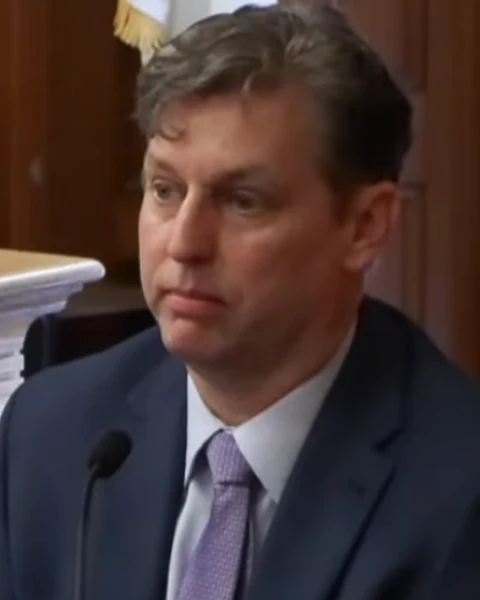
Andrew Rentschler
Testimony Impact
Dr. Andrew Rentschler is a biomechanical engineer and accident reconstructionist employed by ARCCA Inc. who was retained as a defense expert witness in both the first and second Karen Read trials. His testimony centered on whether John O'Keefe's head fracture, arm injuries, and body placement were physically consistent with being struck by the rear tail light of a Lexus LX 570 traveling at the speed alleged by the prosecution. Rentschler conducted physical testing using a Hybrid III anthropomorphic test dummy and analyzed injury patterns, force vectors, and tail light damage to support his conclusion that a vehicle strike did not cause O'Keefe's injuries.
Trial 1 vs Trial 2
Between Trial 1 and Trial 2, the examination of Rentschler expanded significantly in both scope and adversarial intensity. In Trial 1, ADA Lally's cross focused primarily on the materials Rentschler had not reviewed and on post-report evidence such as DNA found on the tail light housing. In Trial 2, the prosecution devoted an entire pretrial voir dire session to his communications with the DOJ and his post-trial socializing with the defense, and ADA Brennan's cross in the substantive proceedings added entirely new lines of attack — the deleted text messages, the documentary appearance, and a detailed challenge to his publication record and reference citations. Rentschler also had more testimony to give in Trial 2, spanning two days of direct examination and presenting new analysis critiquing Dr. Welcher's competing biomechanical testing.
Notable Quotes From The Record
“I'm a biomechanical engineer and accident reconstructionist.”
Establishes the witness's core discipline.
“An injury to the human body is just an engineering problem.”
Frames biomechanical analysis as objective engineering, not medical opinion — foundational to the defense's use of this expert.
“I've testified probably over 150 times in numerous state, federal, civil, and criminal courts throughout the country.”
Establishes extensive expert testimony experience across jurisdictions.
“Specifically overall, I was tasked from the biomechanical standpoint to determine — or see if it's possible to determine — how the injuries in this case occurred, and part of that was to determine whether the injuries, the head injury and the arm injuries, resulted from contact with the Lexus in this case.”
Defines the exact scope of Rentschler's analysis — whether O'Keefe's injuries are consistent with vehicle contact.
“the acceleration is going to be the same. It depends on the mass of whatever body part is being hit. So from the testing that we did at 15 mph, we used a head form which weighs about 11 pounds, and that produced almost 1,000 pounds of force”
Quantifies the force involved — establishes that impacts at alleged speed would cause far more damage than observed
“the fact that we only have that head injury, and only damage to the occipital portion of the skull, is inconsistent, in this case, with being struck by that tail light”
Core expert opinion — isolated skull fracture without cervical or body injuries rules out vehicle strike
“We had more damage to the tail light in that test than what we saw with the subject tail light cover. So if you're going 24 or 25 miles an hour — even faster — you're going to see even greater damage”
Physical testing at 15 mph produced more tail light damage than the actual evidence showed, undermining the prosecution's speed theory
“when you look at the abrasions that were noted in this case, they all appear to be of the same force, generally the same direction, and the same severity, which would be inconsistent, in my opinion, with being struck at 25 mph”
Uniform abrasion pattern contradicts a shattering tail light impact which would produce varied injury severity
“In order to get the complete body, for instance, 10, 20, 30 feet into the yard, you need a force acting at the center of mass. You need an external force pushing the body that way. And that's not going to happen if you just hit the arm”
Physics explanation for why an arm-only strike could not project O'Keefe's body to where he was found
“I didn't have enough evidence based on what I was provided, and even looking at the additional evidence that I became aware of after the fact, there's still no evidence. I mean, you can't deny the science and the physics as to what would have happened if he was struck by the vehicle.”
Rentschler maintains his conclusions despite acknowledging the limited materials, asserting the physics remain unchanged.
“The car could have backed up and not known that he was there and nudged him and caused him to fall. I mean, any event that would cause him to fall backwards obviously would result in him striking his head, so there's numerous, almost infinite possibilities.”
On cross, the defense expert concedes that a low-speed vehicle nudge causing a backward fall is among the possible scenarios for the skull fracture.
“I looked at the records from the defense, but then I looked at my own records, which indicate a different number. Only three phone calls, I believe.”
Rentschler disputes the defense's own call records, creating a factual discrepancy about the extent of pre-testimony contact.
“They did inform me, yes, about testimony and situations and events that came forth in the trial that I was not aware of.”
Admits DOJ provided him trial updates before testifying — relevant to sequestration order compliance.
“No, I was not.”
Rentschler states he was unaware of the sequestration order when DOJ was updating him on trial testimony.
“A — that the force wasn't sufficient, or the acceleration wasn't sufficient, to produce enough force to cause a skull fracture at 15 miles an hour.”
Core expert opinion: drop testing showed a 15 mph tail light impact cannot generate enough force for an occipital skull fracture.
“it would take about 1,400 to 1,600 lb of force to cause an occipital skull fracture”
Establishes the biomechanical threshold that the defense argues a tail light impact at 15 mph cannot reach.
“to have an impact to the back of the head, you really couldn't have someone positioned in such a manner to strike just the head and not have subsequent concomitant injury to the neck or any other part of the body”
Explains why the absence of cervical spine injuries rules out the vehicle-strike theory — biomechanically impossible to hit only the head.
“my opinion was that the injuries would be inconsistent — or the injuries that Mr. O'Keefe sustained on his right arm and didn't sustain — would be inconsistent with actual interaction with the tail light”
Second prong of the defense expert opinion: arm abrasions also inconsistent with tail light contact, and expected fractures were absent.
“I counted 36 different superficial abrasions on his right arm.”
Establishes a key discrepancy: 36 abrasions versus only 9 holes in the sweatshirt sleeve, undermining the tail light contact theory.
“So at 24 miles an hour, for the arm, the acceleration is 302 g's, and for the hand it's about 435 g's.”
Quantifies the forces involved, establishing that impact at alleged speed would far exceed fracture thresholds for hand and arm bones.
“It is my opinion that it is not consistent with contacting and fracturing the tail light cover.”
Core defense opinion rejecting the prosecution's mechanism of injury for the arm.
“There was no bruising. There were no lacerations. There was nothing at the alleged point of contact which would indicate an impact that produces thousands of pounds of force on the arm. No evidence of it whatsoever.”
Summarizes the totality of absent expected injuries that undermines the vehicle strike theory.
“It would not be possible. Our testing demonstrates that. The peer-reviewed articles demonstrate that. I've seen no evidence anywhere in this case that would suggest or even indicate that if you get a glancing blow or a sideswipe blow that somehow would produce enough force to push you 8 to 10 feet into the yard.”
Directly challenges how O'Keefe ended up at his point of rest if only his arm was struck.
“I do not have any source that says it's suitable for determining superficial abrasions.”
Concedes he has no literature supporting the use of Hybrid III crash test dummies for the exact analysis he performed — assessing whether arm contact would produce superficial abrasions.
“Some of those appear sharp. Could possibly cause a laceration. Sure.”
Concession that tail light fragments found in O'Keefe's clothing could cause the type of injuries observed, undermining his opinion that the injuries are inconsistent with tail light contact.
“No, I don't think he even got hit by the car, sir.”
Reveals Rentschler's advocacy position rather than neutral expert analysis, volunteering his belief about the ultimate issue unprompted.
“I said it certainly helped prepare me to understand what was going on during the trial. Yes.”
Prior sworn testimony directly contradicts Rentschler's repeated denials during this cross that receiving trial information from his employer helped him prepare.
“The shard can't come out and then make a right turn and then somehow embed itself on the left side of the nose. That's entirely inconsistent with the fracture and how the glass and the cover would actually move.”
Directly addresses the glass-in-nose evidence raised on cross, explaining why debris trajectory physics rule out a rear vehicle strike.
“If the injuries don't match up, if you can't even prove what happened, then you can't use information or evidence — if you have no idea how it got there — to try and prove what you don't even know happened. It scientifically makes no sense.”
Frames the defense's methodological argument: scene evidence is irrelevant if the biomechanics don't support a collision in the first place.
“No, they are not.”
Rentschler's ultimate opinion — O'Keefe's injuries were not consistent with being struck by the Lexus — stated to a reasonable degree of scientific certainty.
“Well, I don't believe that's consistent with the evidence and what occurred. I mean, someone can get clipped by a car, sure. But in this case, no.”
On recross, Rentschler rejected even the lesser theory of a glancing clip, closing the door on a fallback prosecution theory.
“If it wasn't there, you wouldn't find it.”
Prosecution elicits agreement that absence of tail light debris during the initial leaf blower search could mean it was never there — or simply outside the search area.
“Well, you can sit back or step back and look at whether what someone's claiming makes sense in the bigger picture.”
Rentschler concedes that analysis requires more than physics alone, which Brennan uses to question why Rentschler excluded physical evidence from his reconstruction.
“Oh, I — I don't know. There's no evidence of how it broke.”
Rentschler's inability to explain the tail light damage undermines his certainty that it wasn't caused by striking O'Keefe, leaving a gap in the defense narrative.
Key Moments
- Rentschler testified that ARCCA's physical testing at 15 mph produced more damage to the tail light than was observed on the actual evidence, undercutting the prosecution's theory that the Lexus struck O'Keefe at 24 mph while leaving only the damage present on the recovered tail light pieces.
- Using biomechanical analysis, Rentschler argued that O'Keefe's isolated occipital skull fracture — without accompanying cervical spine or torso injuries — was inconsistent with a vehicle strike, since a tail light impact would have transferred force across a broader area of the body.
- Rentschler explained to the jury that projecting O'Keefe's full body weight to where he was found required a force applied at his center of mass, which an arm-only tail light contact could not have produced, addressing the question of how the body came to rest in that location.
- During the second trial, Rentschler presented slow-motion video analysis of the prosecution's competing expert Dr. Welcher's drop test, contending that Aperture's surrogate had improper body positioning during the test and that the methodology lacked peer-reviewed support and took no measurements.
- At Trial 2's Day 5 voir dire — held weeks before his substantive testimony — Rentschler faced pretrial questioning about his communications with DOJ representatives who briefed him before his Trial 1 appearance and about his social interactions with the defense team following that testimony, previewing the bias attacks that would dominate his cross-examination.