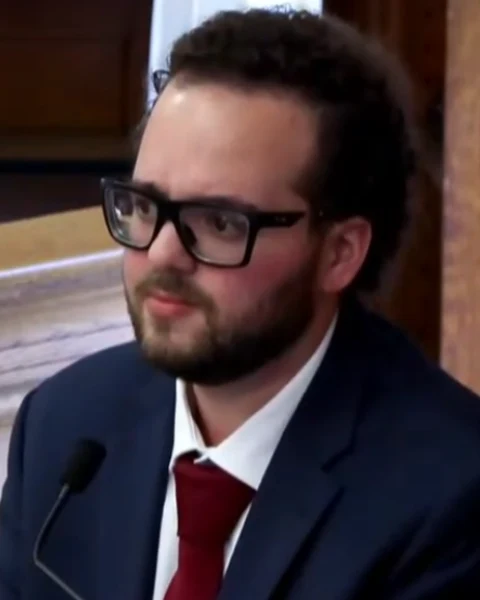
Andre Porto
Testimony Impact
Andre Porto is a DNA analyst at the Massachusetts State Police Crime Lab, accredited by ANAB. He performed autosomal DNA testing on evidence collected from John O'Keefe's clothing, a broken drinking glass recovered from 34 Fairview Road, Read's vehicle tail light, and other items. His testimony established statistically overwhelming DNA matches linking O'Keefe to several key pieces of physical evidence while also documenting the presence of additional unidentified contributors on those same items.
Challenges & Responses
What attorneys challenged during examination and how the witness responded.
In Trial 2, Yannetti challenged the scope of Porto's assignment by asking whether Porto personally had been asked to compare the passenger-side tail-light profile with Kevin Albert or Kenneth Berkowitz and the broken-drinking-glass profile with Brian Albert or Brian Higgins. Porto said he had not been asked to make those named comparisons. His answers describe requests made to him; they do not establish whether other investigators, analysts, or laboratories requested or performed comparisons.
Trial 1 vs Trial 2
In Trial 1, the defense waived cross-examination, leaving Porto's direct testimony unchallenged. In Trial 2, Yannetti conducted a substantive cross focused on the scope of what Porto personally was asked to analyze. Yannetti asked whether Porto had been asked to compare the passenger-side tail-light profile with Kevin Albert or Kenneth Berkowitz and the broken-drinking-glass profile with Brian Albert or Brian Higgins; Porto said he had not. The defense used those questions to challenge the scope of Porto's assignment, but his answers did not establish that no comparison was requested or performed elsewhere.
Notable Quotes From The Record
“The DNA profile from this item is at least 510 nonillion times more likely if it originated from J. O'Keefe and two unknown individuals than if it originated from three unknown unrelated individuals, and this provides support for an inclusion.”
Key finding linking O'Keefe's DNA to the vehicle tail light — central physical evidence in the case
“So the world population I think currently is about 8 billion, which is an eight followed by nine zeros, and 510 nonillion has — excuse me — 30 zeros in it, so it's significantly larger.”
Contextualizes the statistical weight of the DNA match for the jury
“No, it cannot.”
Porto confirms DNA analysis cannot determine when or how DNA was deposited — a limitation relevant to defense theories about evidence
“So we store our DNA extracts in a cold room, so cold temperatures could be very good to help preserve any DNA that's on there.”
Establishes that cold weather conditions would preserve rather than degrade DNA evidence found outdoors
“The DNA profile from this item is at least 510 nonillion times more likely if it originated from John O'Keefe and two unknown individuals than if it originated from three unknown unrelated individuals. This provides support for an inclusion.”
Three-contributor passenger-side tail-light DNA-profile result supporting an inclusion of O'Keefe at the stated likelihood ratio
“So there was no human DNA detected and STR analysis was not performed.”
Hair from the vehicle's exterior passenger-side rear handle yielded no usable DNA, requiring mitochondrial testing at an external lab
“The DNA profile from this item is at least 530 nonillion times more likely if it originated from John O'Keefe and two unknown individuals than if it originated from three unknown unrelated individuals. This supports an inclusion.”
DNA finding on the broken drinking glass exterior from 34 Fairview Road
“So I determined that there were five contributors, so that makes it too complex for us to do comparisons to it.”
One evidence item (sneaker stain) was too complex for comparison, illustrating the limits of the lab's validated protocols
“No, I'm not.”
Porto's confirmation that he cannot determine when DNA was deposited on the tail light, undermining the prosecution's timeline linking it to the night of the incident
“Based on our protocols, we're not able to do any comparisons to any mixtures that are five or more contributors. So it's not suitable for comparisons.”
Explains the lab's limitation on complex DNA mixtures, rendering the sneaker evidence unusable for identification
“That depends. It can happen, but it's possible. Yes.”
Porto's qualified testimony was that multiple DNA contributors on clothing can happen depending on the circumstances, and he would not call that a complete anomaly.
“The DNA profile from this item is 510 nonillion times more likely to have originated from John O'Keefe and two unknown individuals than if it originated from three unknown unrelated individuals.”
Reiterates the overwhelming statistical match of O'Keefe's DNA on the tail light.
“Correct. They were interpreted as originated from a single contributor.”
Confirms the 13 specified stain profiles on O'Keefe's shirts were interpreted as single-contributor DNA; this conclusion does not extend to other clothing samples addressed on cross.
Key Moments
- Porto presented the centerpiece statistical finding of his analysis: the DNA profile on Read's passenger-side tail light was at least 510 nonillion times more likely to have originated from O'Keefe and two unknown individuals than from three unrelated people — a number Porto explained to the jury contains 30 zeros, dwarfing the entire world population of 8 billion.
- Porto testified that one evidence item — a stain on O'Keefe's sneaker — yielded a DNA mixture from five or more contributors, rendering it too complex for comparison under the lab's validated protocols, illustrating the boundaries of what the analysis could establish.
- Porto acknowledged on cross-examination that DNA analysis cannot determine when or how DNA was deposited on an item, a limitation the defense used to contest the interpretive weight of the physical evidence.
- In Trial 2, during Yannetti's cross-examination, Porto testified that he was not asked to compare the passenger-side tail-light DNA profile with Kevin Albert or Kenneth Berkowitz, or the broken-drinking-glass profile with Brian Albert or Brian Higgins; he said the other contributors could be anybody and that he did not know who they were.
- Porto explained that cold storage conditions, consistent with the outdoor overnight environment where O'Keefe was found, would tend to preserve rather than degrade DNA — directly addressing a potential defense argument that the January cold could have compromised the evidence.